HomeConnectorsBigQuery

Marketing data connectors forGoogle BigQuery

Connect 26 marketing platforms to BigQuery with zero code, automated syncs, and an AI-native query builder that delivers schema-optimized tables in under 5 minutes.

  • Data blendingAutomatic mapping of dates, campaigns and metrics across channels in the same connection.
  • Multi-accountCombine multiple accounts of the same data source in one single connection.
  • 30+ data sourcesAll the major marketing platforms, analytics, ecommerce and CRM tools.
Sources
+18
Send to
BigQuery
Testimonials

Loved by 1,500+ marketers.

Agencies, freelancers and in-house teams who stopped fighting their BigQuery connectors.

Other destinations

Porter ships your marketing data to 10+ destinations beyond BigQuery — same subscription, no extra seats, no per-destination fees.

Data warehouse1
Workflow automation1
Use cases

Free BigQuery dashboards

Real workflows marketers ship with Porter — built on top of your live data.

Cross-Channel PPC Reporting in BigQuery

Unify Meta Ads, Google Ads, TikTok Ads, and LinkedIn Ads into a single BigQuery dataset to compare cost, impressions, and conversions across all paid channels.

Integrations:meta-adsgoogle-adstiktok-adslinkedin-ads

Read tutorial

E-Commerce Attribution & ROAS in BigQuery

Combine Shopify sales data with Meta and Google Ads spend to calculate true ROAS, customer acquisition cost, and lifetime value inside BigQuery.

Integrations:shopifymeta-adsgoogle-ads

Read tutorial

Multi-Client Agency Reporting in BigQuery

Consolidate Meta Ads and Google Ads data from multiple client accounts into one BigQuery warehouse for automated, scalable agency dashboards.

Integrations:meta-adsgoogle-ads

Read tutorial

BigQuery connector feature checklist

What makes Porter Metrics connectors better than any other on the market.

01

Live API data

Porter queries the source API directly, so your data is always up-to-date. Turn on storage for extra speed and stability.

02

Unlimited historical data

Access your full source history with no cutoffs. Analyze trends over any time period without API limits.

03

No-code data warehousing

Porter ships with a built-in BigQuery warehouse that automatically manages backfills for rate-limited APIs (HubSpot, Shopify). No SQL, no schema setup.

04

All destinations included

Data Studio, Sheets, Power BI, BigQuery, Slack and Zapier are part of every plan. No per-destination fees, no extra seats.

05

Multi-account at scale

Blend dozens of accounts of the same source into one unified table. Built for agencies managing many clients.

06

Transparent accuracy

Your numbers match the source manager exactly. Porter doesn't transform, sample or reinterpret your data.

07

Full granularity

Segment by every metric and dimension the API exposes. No pre-cooked schemas, no hidden fields.

08

Automatic data blending

Dates, campaign names, UTM parameters, spend, impressions, clicks, conversions and revenue unified across sources. No table creation, no field mapping, no SQL. Trusted by 1,500+ marketing teams in 60 countries.

Tutorial

How to connect any source to BigQuery

  1. Pick your data source

    Choose any of the 25+ connectors from the grid above — Meta Ads, Google Ads, TikTok, GA4, Shopify, HubSpot and more.

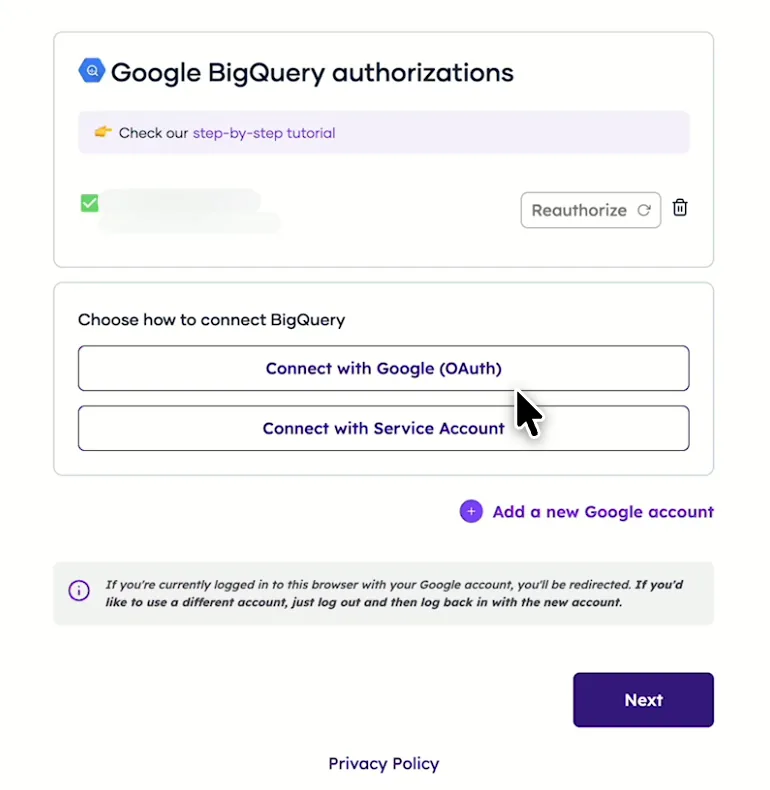
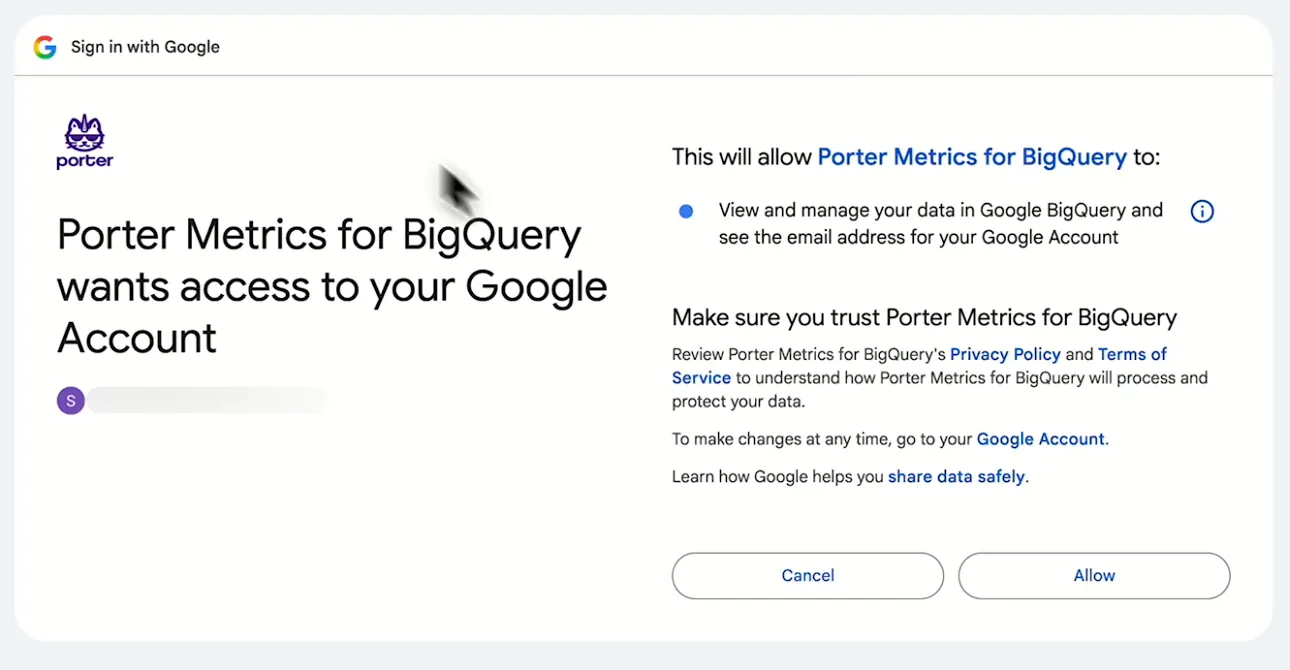
  2. Log in with your Google account

    Use the same Google account you use on BigQuery.

  3. Authorize the source with OAuth

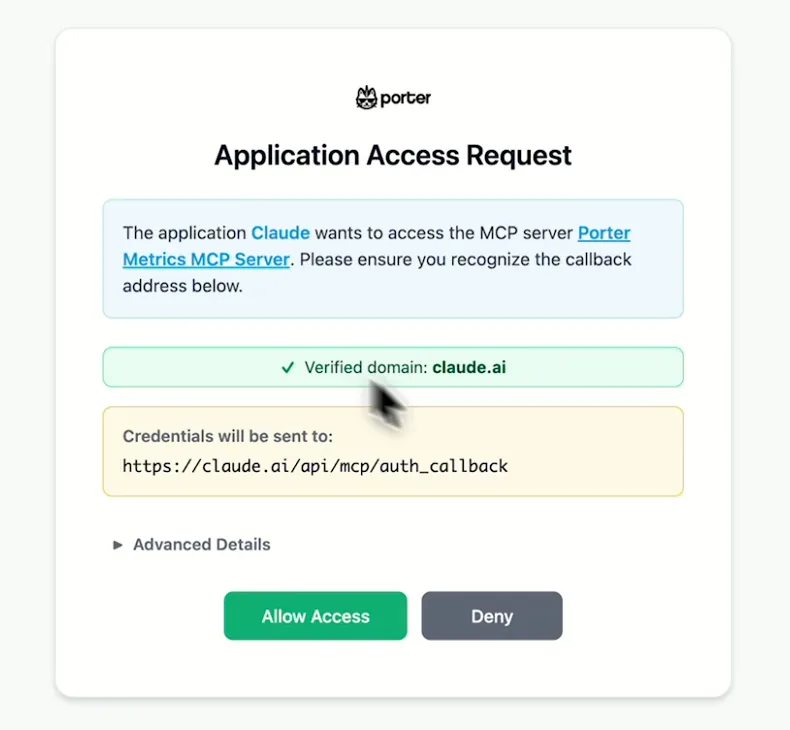
    Grant read-only access. You can revoke it anytime from your account.

  4. Select the accounts to blend

    Pick one account or blend multiple into a single data source — perfect for agencies.

  5. Create your report in BigQuery

    Load a free Porter template or start from scratch. Your fresh data is ready.

Full tutorial: Getting started with Porter for BigQuery →

Pricing

Start free. Pay per data source account

  • Unlimited 14-day free trialConnect any number of data source accounts — no credit card.
  • Free forever planPer account: up to 3 connected accounts with 30-day history.
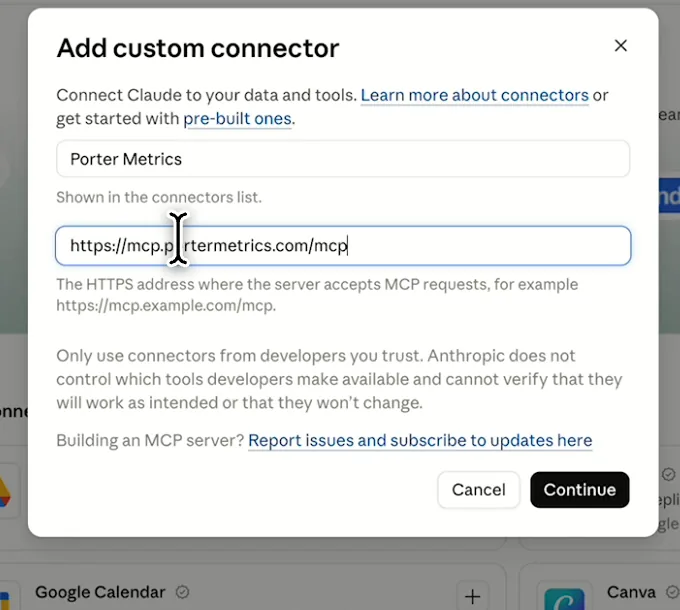
  • Other destinations includedYour subscription sends data to Data Studio, Google Sheets, BigQuery, Slack and Claude/ChatGPT.
  • Unlimited usersNo extra cost per team member or seat.
Monthly

Annual Save 17%

Number of data source accounts


$12.5
/mo

Billed annually · /account

Destinations included

Claude
ChatGPT
Data Studio
Google Sheets
Slack
Zapier
Power BI

Start for free →

Unlimited 14-day free trial + Free forever plan

FAQ

Common questions.

What is BigQuery?

Google BigQuery is a fully managed, serverless data warehouse built on Google Cloud Platform that enables fast SQL analytics over petabyte-scale datasets using a pay-per-query pricing model. Launched in 2011, it was among the first enterprise data warehouses to separate storage from compute, allowing organizations to scale each independently without provisioning servers or managing infrastructure.

BigQuery stores data in columnar format and executes queries through a distributed architecture that can scan terabytes in seconds. It supports standard SQL, nested and repeated fields, and integrates natively with the Google Cloud ecosystem including Google Ads, Google Analytics 4, and Looker Studio (formerly Data Studio). Data teams use it as a central repository for structured and semi-structured data, running ad-hoc analysis, scheduled reporting, and machine learning workflows through BigQuery ML. For marketing teams specifically, BigQuery solves the problem of data fragmentation: instead of pulling reports from individual platforms, teams can load all marketing data into one warehouse and query it with SQL.

Why use BigQuery for marketing?

Marketing teams adopt BigQuery to solve three recurring problems: fragmented data silos, slow manual reporting, and the inability to run cross-channel attribution at scale.

First, **unified cross-channel analysis**. BigQuery allows marketers to consolidate data from advertising platforms, CRMs, web analytics, and offline sources into a single schema. This makes it possible to calculate true customer acquisition cost across channels, identify overlapping audiences, and build custom attribution models that no individual platform provides.

Second, **automated reporting at scale**. Instead of exporting CSVs or relying on spreadsheet-only workflows, teams can schedule SQL queries to refresh dashboards hourly or daily. This eliminates version-control issues and reduces the time spent reconciling numbers between platforms.

Third, **machine-learning-ready data infrastructure**. BigQuery ML lets teams build predictive models—such as churn probability or lifetime value estimates—directly on warehouse data without moving it to separate tools. Teams typically choose BigQuery over general-purpose BI tools when their data volume exceeds what in-memory or local databases can handle, when they need to join large datasets from multiple sources, or when they want to reduce infrastructure overhead by using a fully managed service.

What is a BigQuery connector?
A BigQuery connector is a piece of software that brings data from a third-party tool (like Meta Ads or Shopify) into a BigQuery report, so you can build dashboards on top of it. Porter provides managed connectors that handle authentication, schema and rate limits for you.
Are Porter connectors native to BigQuery or third-party?
Porter connectors are partner connectors — they appear inside the BigQuery connector gallery automatically once you sign up. You don't need to install anything manually; just search "Porter" when adding a new data source in BigQuery.
Is there a free plan?
Yes. Porter's free plan gives you 3 data source accounts across any connectors with a 30-day data history. You can upgrade anytime without reconnecting accounts. BigQuery itself is also free.
How often does data refresh in BigQuery?
Porter refreshes data on a scheduled basis (hourly or daily depending on the source) and caches it for fast BigQuery loading. You can also force a refresh manually from your Porter dashboard.
Do I need to install anything in BigQuery?
No. Porter connectors are available inside the BigQuery partner connector gallery as soon as you create a Porter account. Just add a new data source inside BigQuery and search for the connector you need.
Can I blend multiple Porter connectors in one BigQuery report?
Yes. Porter pre-standardizes field names across sources, so you can blend Meta Ads + Google Ads + GA4 (and more) in a single BigQuery report with matching campaign, date and UTM fields.
What if I hit the source's API rate limits?
Porter stores a BigQuery copy of your data as a safety net. If you hit Meta's, Google's or TikTok's API rate limits, Porter automatically falls back to the stored version so your dashboards keep working.

Start in 2 minutes

Automate your reports in Google BigQuery

No credit card · Cancel anytime · 1,500+ marketers