





Why you can trust this review
- Written by Juan Bello, founder of Porter Metrics (a Funnel.io competitor) with 6+ years building marketing data tools
- Every claim is sourced from public data: G2, Capterra, Trustpilot, Reddit, Wayback Machine, Vendr SaaS data
- Pricing verified via direct scraping of funnel.io/pricing and historical snapshots from the Internet Archive
- Pros AND cons included — we’re transparent about where Funnel.io excels, even where it outperforms Porter Metrics
What is Funnel.io
Funnel.io is a marketing data hub that connects advertising, analytics, and CRM platforms to your preferred reporting destinations. It collects raw marketing data from 590+ connectors, normalizes it (cleaning field names, currencies, time zones), and sends it to tools like Data Studio (formerly Looker Studio), Google Sheets, BigQuery, Snowflake, or Tableau.
Funnel.io positions itself as the layer between your marketing platforms and your BI tools. It does not build dashboards or reports itself — it moves and cleans data so that other tools can visualize it. Think of it as a marketing-specific ETL (Extract, Transform, Load) pipeline.
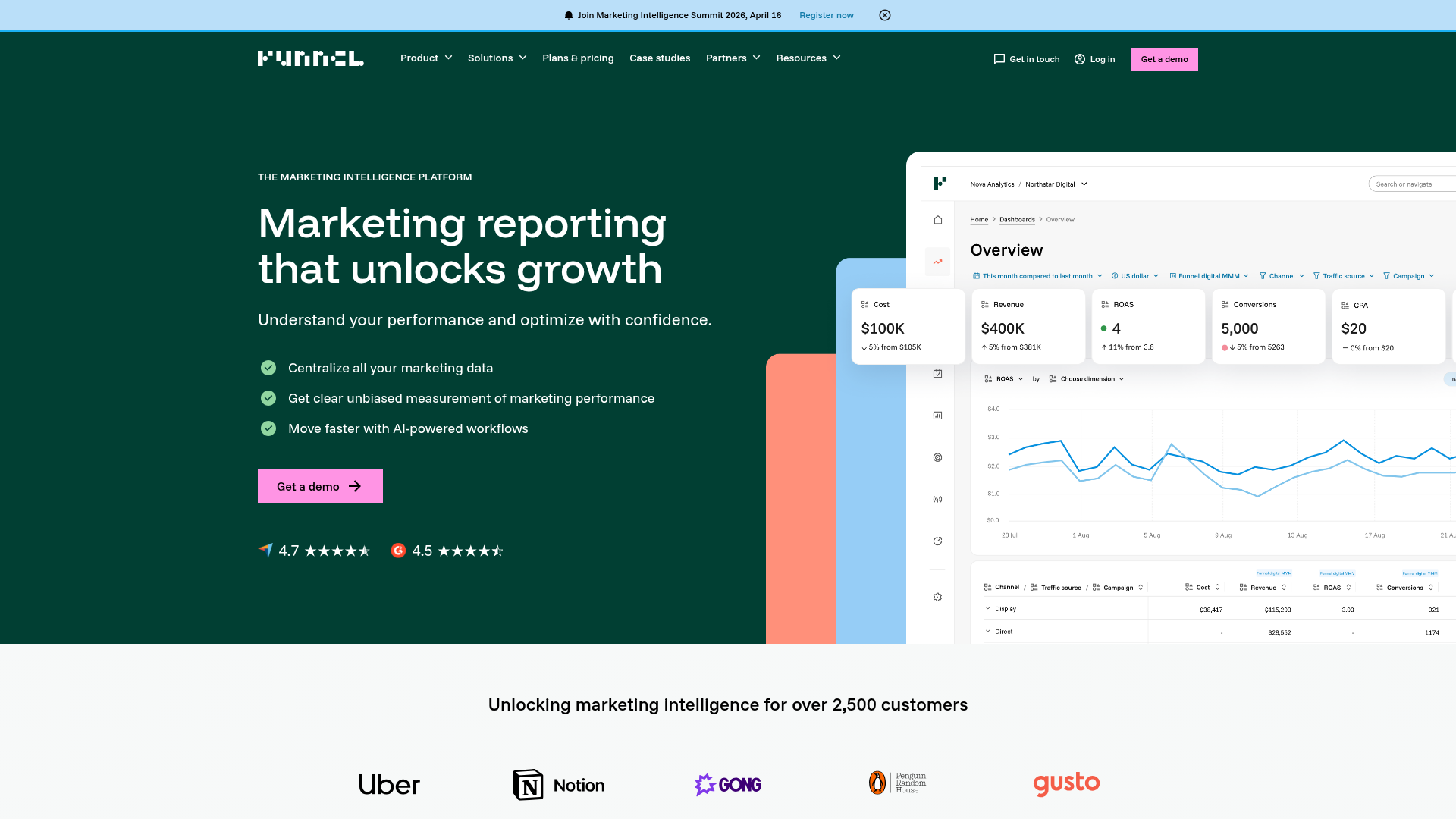
Funnel.io homepage (captured April 2026)
Who is it for
- Enterprise marketing teams with 50+ data source accounts that need centralized data governance
- Data-savvy organizations that already use BI tools (Tableau, Looker, Power BI) and need a reliable data pipeline
- Large agencies managing multiple clients who need consistent data normalization across accounts
Key differentiators
590+ connectors
One of the largest connector libraries in the marketing data space, covering advertising, social media, SEO, CRM, e-commerce, and more.
Data normalization
Automatic field mapping, currency conversion, and timezone alignment across all connected sources. Funnel.io standardizes campaign names, metrics, and dimensions.
Enterprise compliance
SOC 2 Type II, ISO 27001, GDPR, and CCPA certified. Enterprise-grade security with SAML SSO and role-based access controls.
Company background
Funnel.io was founded in 2014 in Stockholm, Sweden. The company has raised over $80 million in funding and serves enterprise clients globally. Funnel.io has grown from a startup focused on Google Ads data to a full marketing data platform with 590+ integrations.
The company has undergone significant pricing changes in 2025-2026, moving from a freemium model to an enterprise-first pricing strategy that has been controversial among users.
The 590+ connectors
Funnel.io’s connector library is organized by plan tier:
- Starter (121 connectors): Core marketing platforms — Google Ads, Meta Ads, LinkedIn Ads, Google Analytics, TikTok Ads, Shopify, HubSpot, and more
- Business (579 connectors): All Starter connectors plus niche platforms, affiliate networks, programmatic advertising, and advanced CRM integrations
- Enterprise (590 connectors): All Business connectors plus custom-built integrations on request
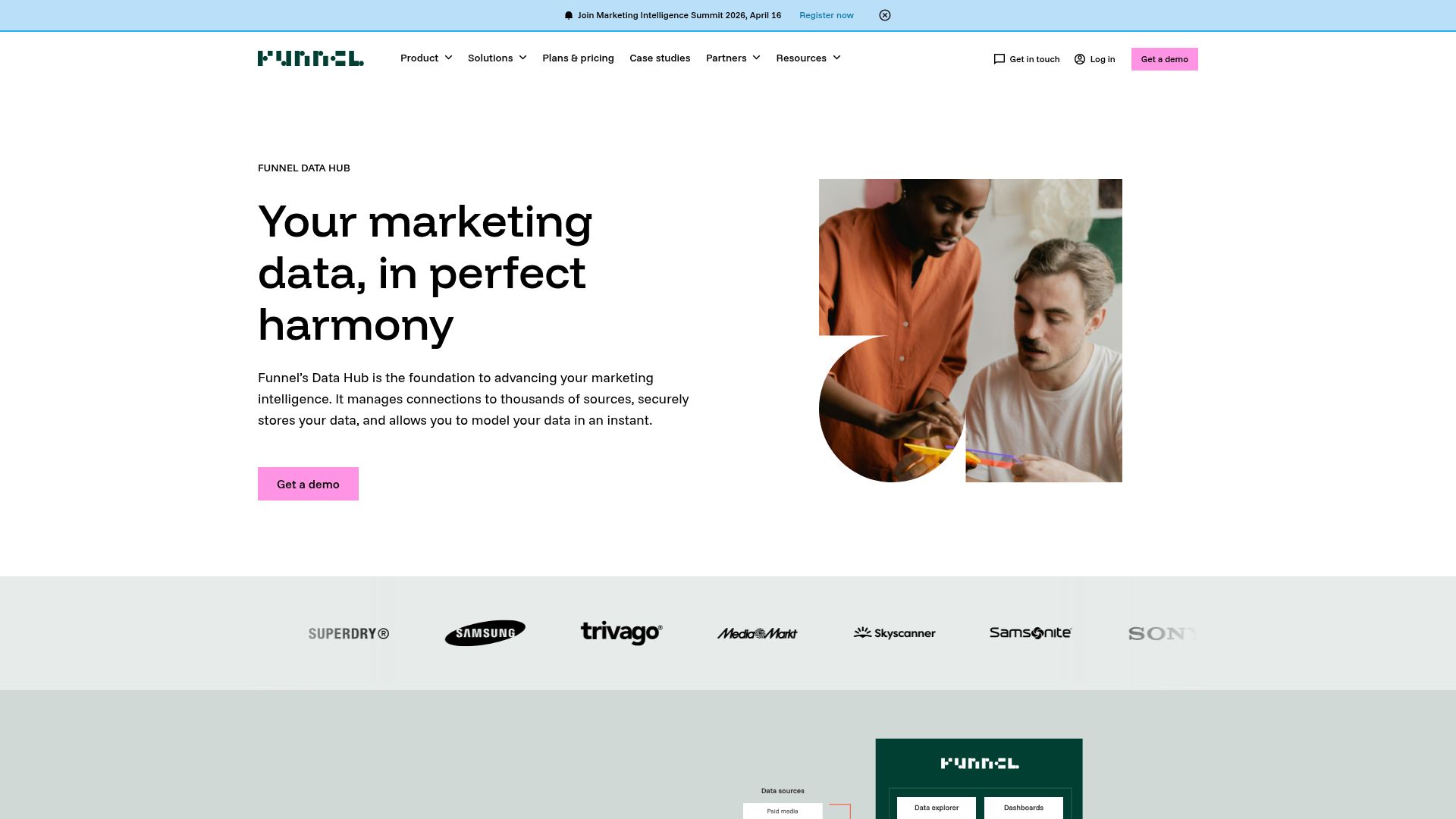
Funnel.io Data Hub page (captured April 2026)
Destinations
Funnel.io supports a wide range of data destinations:
- BI Tools: Data Studio, Tableau, Power BI
- Spreadsheets: Google Sheets, Excel
- Data Warehouses: BigQuery, Snowflake, Amazon Redshift, Azure Synapse
- Storage: Amazon S3, Google Cloud Storage
- Databases: PostgreSQL, MySQL
- Native dashboards: Funnel.io’s own built-in reporting (limited customization)
Destination access varies by plan. The Starter plan includes basic destinations (Data Studio, Google Sheets), while warehouses and databases require higher-tier plans.
Core features
Data collection and normalization
Funnel.io automatically collects data from connected sources on a schedule (daily on Starter, every 2 hours on Business/Enterprise). The platform normalizes field names, aligns date formats, converts currencies, and deduplicates records. This is Funnel.io’s core value proposition: making messy marketing data clean and consistent.
Data transformation
Funnel.io provides tools to transform data after collection: calculated metrics, custom dimensions, data blending across sources, and rule-based categorization. Transformations are defined through a visual interface — no SQL required, though SQL access is available on higher plans.
Flexpoints system
All Funnel.io usage is measured in Flexpoints — a credit-based system where each connector, destination, and feature consumes points. This determines your actual cost beyond the base plan price. More connectors, more frequent refreshes, and more destinations all consume additional Flexpoints.
Built-in dashboards
Funnel.io includes native dashboards for internal analysis. These are functional for quick data exploration but are generally not customizable enough for client-facing reports. Most users combine Funnel.io with a dedicated BI tool for visualization.
AI summaries and forecasting
On higher-tier plans, Funnel.io offers AI-powered features including automated summaries of performance changes, anomaly detection, and basic forecasting. These are relatively new additions (2025-2026).
Pricing
Funnel.io uses a Flexpoints-based pricing model where your total cost depends on the number of connectors, destinations, data refresh frequency, and features used.
Funnel.io pricing (source: funnel.io/pricing, verified April 2026)
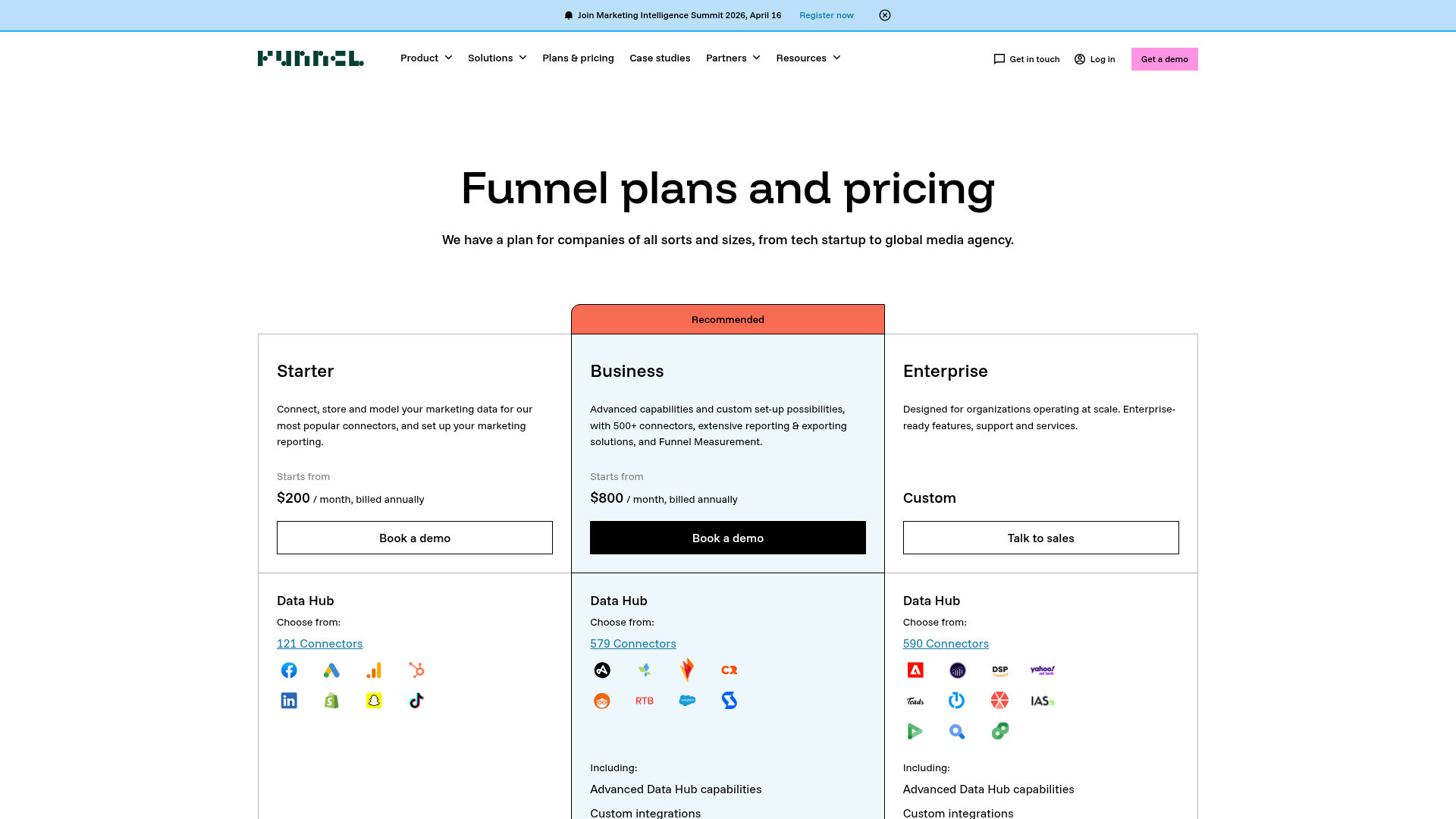
Funnel.io pricing page (captured April 2026). Note: displayed prices may vary based on Flexpoints configuration.
Key pricing facts:
- No free plan available (removed in December 2025)
- No self-service signup — you must book a demo to get pricing
- Costs scale with Flexpoints: each connector, destination, and feature adds credits
- Average contract is $73,500/year according to Vendr transaction data
- Small teams connecting 5-10 ad accounts can expect $4,800+/year minimum
- Large implementations can exceed $1 million/year
Hidden costs and gotchas
Based on user reviews from G2, Reddit, and competitor analyses (AgencyAnalytics, Dataslayer), here are the most common billing surprises:
Flexpoints creep
Each connector, destination, and feature consumes Flexpoints. Users report costs gradually doubling from $400/month to $2,000-6,000/month as they add accounts and destinations. One Reddit user: “Flexpoints are the bane of my existence. Funnel does some things extremely well, but nickel-and-diming you for every integration is one of them.”
Extra fees for basic destinations
Destinations like Power BI and Google Sheets that are free on most competitors may incur additional Flexpoint costs on Funnel.io depending on your plan and usage.
30-day cancellation notice
Even for smaller plans, Funnel.io requires a 30-day notice to cancel. You cannot cancel immediately if the tool doesn’t meet your needs.
Paid support tiers
Priority support and dedicated account management are only available on higher-tier plans. Starter plan users get in-app support only.
Connector counting quirks
Broad integrations count separately. For example, two tabs of the same Google Sheet count as two connectors, each consuming Flexpoints. This can inflate costs for teams with many spreadsheet-based workflows.
Pricing history (Wayback Machine verified)
Funnel.io has changed its pricing model significantly over the past 18 months:
| Date | Starter Plan | What Changed |
|---|---|---|
| Jan 2025 | Free (121 connectors, 5 users) | Freemium model with generous free tier |
| Nov 2025 | Free (limited: 4 connectors, 400 Flexpoints) | Free tier severely limited; most features moved to paid plans |
| Dec 2025 | Free plan removed | Existing free users given grace period until Feb 4, 2026 |
| Feb 2026 | ~$400/month | Starter plan now paid; Flexpoints billing system in effect |
| Apr 2026 | ~$400/month base (up to $2,250/mo with add-ons) | Digital measurement add-ons push pricing to $2,250/month+ |
Sources: Wayback Machine snapshots of funnel.io/pricing (Jan 2025, Nov 2025, Apr 2026), Dataslayer.ai analysis, Vendr SaaS transaction data.
Who is Funnel.io for
- Enterprise marketing operations teams that manage 50+ data source accounts and need centralized data governance with SOC 2 / ISO 27001 compliance
- Organizations with existing BI infrastructure (Tableau, Looker, Power BI) that need a reliable marketing data pipeline feeding into their stack
- Large agencies with custom reporting needs that justify the $50,000+ annual investment and have dedicated data analysts to manage the platform
- Companies that need 500+ connectors including niche platforms, affiliate networks, and programmatic advertising sources not available elsewhere
Who is Funnel.io NOT for
- Small marketing teams or freelancers — at $400/month minimum with no free tier, Funnel.io costs more per year than most teams’ entire tool budget
- Teams that need dashboards and reports — Funnel.io moves data but doesn’t create polished reports. You’ll need a separate BI tool on top
- Budget-conscious agencies — the Flexpoints model makes costs unpredictable. Teams regularly report bills doubling as they add accounts and destinations
- Teams that want transparent pricing — you must book a demo to get a quote. There’s no self-service signup or simple pricing page
- Marketers who prefer ready-to-use solutions — Funnel.io has a steep learning curve and requires data expertise to configure properly
Honest limitations
Unpredictable costs
The Flexpoints system makes it nearly impossible to predict your actual bill. Users on G2 and Reddit consistently cite billing surprises as the #1 complaint. One Reddit user called Flexpoints “the bane of my existence.”
Steep learning curve
Funnel.io is a powerful platform, but it requires significant onboarding and data expertise. It’s not a plug-and-play solution. Reviews on Whatagraph and G2 consistently mention “minimal in-platform guidance.”
Data reliability issues
Multiple reviews (G2, Whatagraph, Reddit) mention “frequent complaints about missing or unreliable data” and connector quirks like two tabs of the same Google Sheet counting as two separate integrations.
Limited native reporting
Funnel.io’s built-in dashboards exist but are basic. Most users need Data Studio, Tableau, or Power BI on top of Funnel.io, adding both cost and complexity to the stack.
Plan-gated connectors
Only 121 of the 590 connectors are available on the Starter plan. Most specialized connectors require Business or Enterprise plans, which start at significantly higher price points.
What users say
Based on reviews from G2, Capterra, Trustpilot, and Reddit (compiled April 2026):
- Massive connector library (590+) covering platforms most competitors don’t support
- Strong data normalization — automatic field mapping, currency conversion, timezone alignment
- Enterprise compliance (SOC 2, ISO 27001, GDPR) that satisfies corporate security teams
- Flexible file import for platforms without native connectors
- Works well with popular BI tools like Data Studio, Tableau, and Power BI
- Pricing is expensive and unpredictable — Flexpoints billing leads to surprise increases
- Connector quirks: broad integrations count separately (e.g., two Google Sheet tabs = two integrations)
- Missing or unreliable data reported across multiple review platforms
- No transparent pricing — must book a demo and use a price calculator
- Steep learning curve with minimal in-platform guidance for new users
- Free plan removed in late 2025, frustrating existing free-tier users
Direct quotes from users
“Flexpoints are the bane of my existence. Funnel does some things extremely well, but nickel-and-diming you for every integration is one of them.”
— Reddit user, r/PPC (via Dataslayer analysis)
“Funnel.io is a powerful data integration tool but quickly becomes expensive and complex to manage without a dedicated data team.”
— Whatagraph independent review (2026)
“Comprehensive data integration, user-friendly and clean interface, customizable dashboards.”
— VirtualValley review
“Many inconveniences for those seeking immediate, transparent pricing.”
— Windsor.ai competitor analysis
G2 rating: 4.5/5 · Capterra rating: 4.7/5 · Whatagraph independent review: 4.5/5
Funnel.io vs Porter Metrics
Since this review is written by the founder of Porter Metrics, here is a transparent head-to-head comparison:
| Criteria | Funnel.io | Porter Metrics | Winner |
|---|---|---|---|
| Connectors | 590+ | 25+ | Funnel.io (by far) |
| Starting price | ~$400/mo | $15/mo (free plan available) | Porter Metrics |
| Data normalization | Advanced (currency, timezone, field mapping) | Automatic cross-channel blending | Funnel.io (more granular) |
| Data Studio templates | None included | 50+ installable in one click | Porter Metrics |
| Built-in dashboards | Basic (need external BI tool) | Via Data Studio, Sheets, Power BI | Tie (different approaches) |
| Pricing transparency | Flexpoints (opaque, demo required) | Fixed per-account pricing on website | Porter Metrics |
| Enterprise compliance | SOC 2, ISO 27001, GDPR, CCPA | NDAs, client-owned BigQuery (not SOC2) | Funnel.io |
| Warehouse destinations | BigQuery, Snowflake, Redshift, Azure, S3 | BigQuery (built-in managed) | Funnel.io (more options) |
| AI features | Summaries, forecasting (higher plans) | AI Workflow Builder, natural language queries, custom metrics | Porter Metrics (more practical) |
| Best for | Enterprise teams needing 500+ connectors and SOC 2 | Marketing teams and agencies on Data Studio | Depends on your needs |
Bottom line: Choose Funnel.io if you need 500+ connectors, Snowflake/Redshift destinations, or SOC 2 compliance. Choose Porter Metrics if you want simpler pricing, ready-to-use templates, and AI automation at a fraction of the cost.
Funnel.io alternatives
If Funnel.io’s pricing, complexity, or limitations don’t fit your needs, here are the top alternatives:
| Tool | Best for | Starting price | Connectors |
|---|---|---|---|
| Porter Metrics | Marketing teams & agencies on Data Studio/Sheets | $15/mo | 25+ |
| Supermetrics | High-volume ETL to warehouses and spreadsheets | $37/mo | 150+ |
| Windsor.ai | Multi-touch attribution on a budget | $23/mo | 325+ |
| Improvado | Enterprise alternative with similar capabilities | Custom | 500+ |
| Domo | All-in-one BI platform with free tier | $0 (free) | 1,000+ |
📖 Read our full comparison: 10 Best Funnel.io Alternatives in 2026
Frequently asked questions
Funnel.io can be worth the price for enterprise teams with 50+ data sources that need advanced data normalization and SOC 2 compliance. For small to medium teams, the average contract of $73,500/year is hard to justify when alternatives like Porter Metrics ($15/mo), Supermetrics ($37/mo), or Windsor.ai ($23/mo) cover the same core marketing connectors at a fraction of the cost.
No. Funnel.io removed its free plan in December 2025. Previously, there was a free Starter plan with 121 connectors and 5 users. As of April 2026, all plans require a paid subscription starting at approximately $400/month, and you must book a demo to get a quote.
Flexpoints are Funnel.io’s credit-based billing system. Each connector, destination, data refresh frequency, and feature you use consumes Flexpoints. Your total bill depends on how many Flexpoints you use each month. If you stop using a feature, those Flexpoints free up for use elsewhere. This model makes costs flexible but also unpredictable — many users report surprise billing increases.
Funnel.io has more connectors (590 vs 150+) and stronger data normalization capabilities, but costs significantly more. Supermetrics starts at $37/month with a self-service signup, while Funnel.io starts at ~$400/month and requires a demo call. Supermetrics is better for small-medium teams; Funnel.io is better for enterprise teams with complex data governance needs.
Yes, Funnel.io supports Data Studio as a destination. However, note that Funnel.io only sends data to Data Studio — it does not provide dashboard templates or pre-built reports. You’ll need to build your own Data Studio reports from scratch. If you want pre-built templates and a simpler Data Studio experience, consider Porter Metrics (50+ templates included) or Dataslayer.
The bottom line on Funnel.io
Funnel.io is a powerful enterprise marketing data platform with an industry-leading connector library (590+), strong data normalization, and enterprise-grade compliance. It is a legitimate option for large organizations that need centralized marketing data governance and can justify the $50,000-100,000+ annual investment.
However, for the majority of marketing teams and agencies, Funnel.io is overkill in complexity and cost. The removal of the free plan, the opaque Flexpoints pricing, and the need for a separate BI tool on top make it a hard sell when alternatives like Porter Metrics ($15/mo), Supermetrics ($37/mo), and Windsor.ai ($23/mo) cover the same core use cases at 10-50x lower cost.
If you’re evaluating Funnel.io, ask yourself: do you need 500+ connectors and enterprise compliance? If yes, Funnel.io is a top contender. If not, you’ll likely find better value elsewhere.
Sources
All claims in this review are based on the following public sources, verified April 2026:
- G2 — Funnel Reviews 2026 (4.5/5 rating)
- Capterra — Funnel Software Reviews (4.7/5 rating)
- Trustpilot — Funnel.io Reviews
- Reddit r/PPC — Funnel.io discussion
- Whatagraph — Honest Funnel.io Review 2026
- VirtualValley — Comprehensive Funnel.io Review
- AgencyAnalytics — Funnel.io Pricing: Hidden Costs
- Dataslayer — Funnel.io Raised Prices Analysis
- Windsor.ai — Funnel.io Alternatives & Competitors
- Funnel.io Help Center — Understanding Flexpoints
- Wayback Machine: Jan 2025, Nov 2025, Apr 2026 pricing snapshots