Connecting Claude to Meta Ads with Porter lets you analyze campaigns, build dashboards, and trigger alerts in natural language — like this one:
| Campaign | Spend | Purchases | CPP | ROAS |
|---|---|---|---|---|
| BF_Prospecting_Video | $12,480 | 612 | $20.39 | 6.8x |
| Retargeting_30d_DPA | $8,900 | 398 | $22.36 | 5.4x |
| LAL_1%_Purchasers | $7,210 | 281 | $25.66 | 4.1x |
| Broad_Advantage+ | $15,100 | 510 | $29.61 | 3.8x |
| Interest_Fashion_18-34 | $5,600 | 169 | $33.14 | 2.9x |
MCP (Model Context Protocol) is Anthropic’s open standard for connecting AI assistants to external data sources. The Porter Metrics MCP is the server that exposes your Meta Ads data — along with 20+ other marketing data sources — to Claude in a format Claude can query directly.
Before MCP, getting Meta Ads data into Claude meant exporting a CSV, pasting it in, and asking Claude to read it. That works for one-off questions. It fails at scale, and it fails for agencies. The Porter MCP replaces that manual loop with a live integration: Claude sees your Meta Ads account the way a data analyst would — campaigns, ad sets, ads, creatives, audiences, and all the metrics underneath — and queries what it needs when you ask.
Because Porter already handles Meta Ads authentication, field naming, account consolidation, and multi-destination routing for thousands of marketing teams, the MCP is not a bolt-on — it is the same pipeline that feeds your Data Studio (formerly Looker Studio) dashboards, exposed in a way Claude can read.
Every question your CMO asks takes four tabs to answer. Open Ads Manager, export a CSV, drop it in Data Studio, write the summary in Slack. The question took six seconds; the answer takes forty-five minutes.
That gap is where good performance decisions go to die. Creative fatigue gets caught days late because nobody checks every Facebook and Instagram ad every day. Agencies scale reporting by hiring analysts, not by shipping insight faster. And cross-channel questions — “which Meta campaigns actually drove Shopify revenue last month?” — go unanswered because joining the datasets manually isn’t worth the hour it takes.
If your team still exports Meta Ads CSVs to answer basic questions, this page is for you.
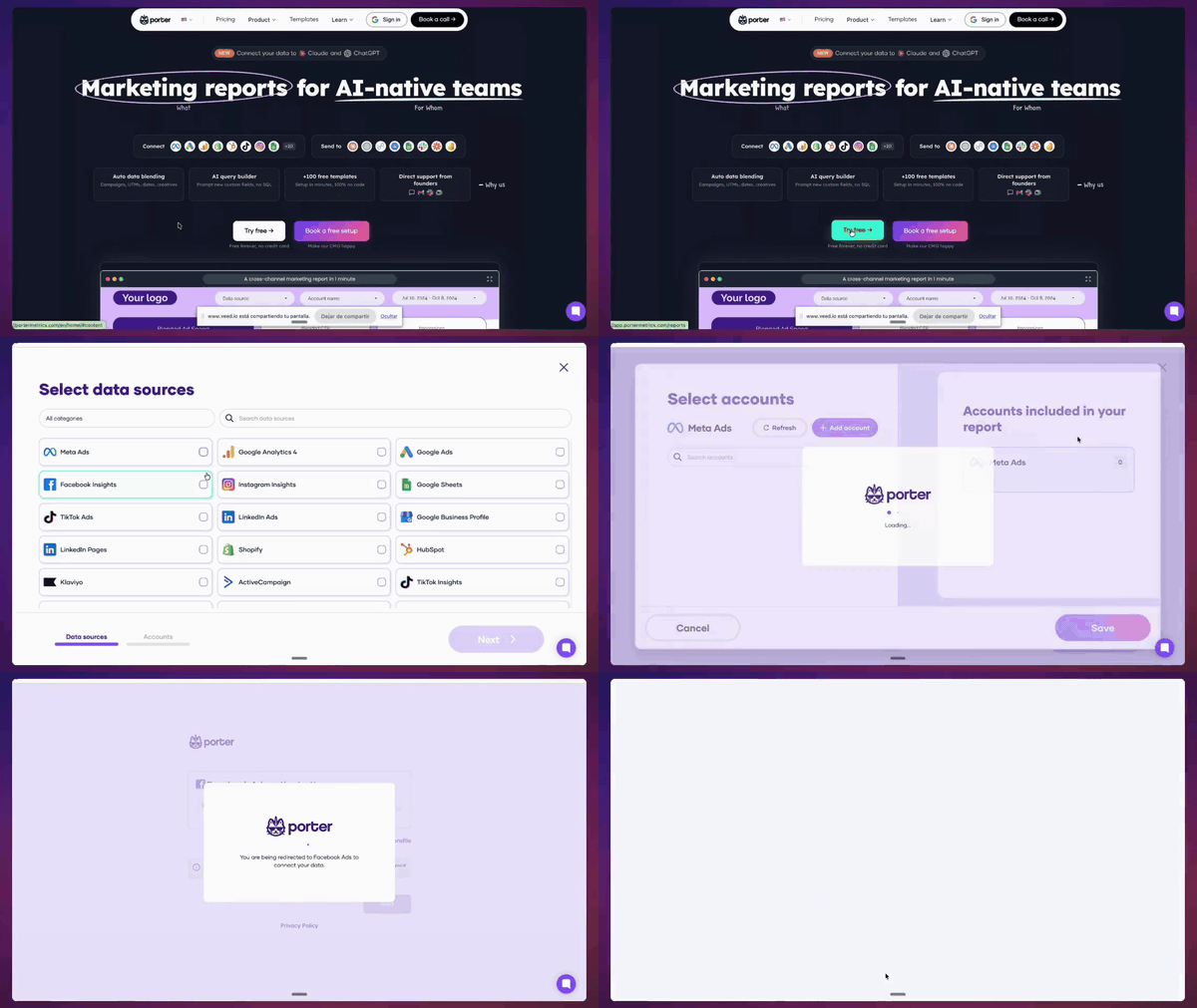
Authenticate once with Meta Business Manager using OAuth. Porter pulls every ad account, campaign, ad set, and ad automatically — including agencies managing 50+ client accounts under one subscription. Covers Facebook Ads, Instagram Ads, Messenger, and Audience Network placements in a single integration. Porter never stores your Meta password and never calls the Meta Marketing API directly from Claude.
In Claude Code, run claude mcp add porter. In Claude Desktop, paste the MCP config block from Porter. Claude Web picks it up the moment you log into Porter. Same MCP endpoint across all three surfaces.
Type the question in English. Claude picks the right fields, runs the query against Porter’s API, and writes the answer. No SQL, no UI clicking, no exports. A question that took forty-five minutes in Data Studio takes forty-five seconds in Claude.
The MCP + Meta Ads space is crowded. Here’s how the Porter Metrics MCP integration compares on the dimensions that matter for marketing teams:
| Criterion | Adzviser | Pipeboard | Coupler.io | Windsor.ai | Porter |
|---|---|---|---|---|---|
| Pricing published on product page | Trial $0.99 | Hidden | Hidden | Hidden | $19/mo published |
| Marketer-language field names | Partial | No | Partial | Yes | Yes (250+ renamed) |
| First-class Claude Code support | No | Mentioned | No | No | Yes |
| Multi-account agency workflow | Yes | Yes | Setup req. | Yes | 50+ accounts, one subscription |
| Multi-destination (not just Claude) | Claude + GPT | Claude + GPT + Cursor | Claude + GPT | Claude + GPT | Claude + Data Studio + BigQuery + Sheets + Slack + Zapier |
| Cross-source joins in one prompt | Yes | Meta + Google + TikTok | Yes | Yes | 20+ connectors, one MCP |
| Prompt library included | No | No | No | 15 prompts | 50+, tagged |
| Read-only by default | Yes | Yes (write opt-in) | Yes | Yes | Yes |
Porter is the only MCP connector built equally for the Claude surface and the classic marketing destinations. The integration is not a bolt-on — the same Porter workspace that feeds your Data Studio reports is the one Claude reads, so the KPIs your team already trusts are the ones Claude sees.
The Porter Metrics integration exposes more than 250 Meta Ads fields, named the way marketers think about them — not the way the Meta Marketing API returns them. Where the API returns actions_omni_purchase, Porter shows purchases. Where the API returns action_values, Porter shows purchase value and ROAS. Claude queries these directly.
Spend, budget, daily budget, lifetime budget, budget remaining, bid amount, bid strategy.
Impressions, reach, frequency, clicks, unique clicks, CTR, unique CTR, CPC, CPM, CPP.
Purchases, purchase value, ROAS, cost per purchase, leads, cost per lead, add to cart, initiate checkout, content view, registration.
Campaign name, objective, buying type, bid strategy, status, start date, stop date, special ad categories.
Ad set name, optimization goal, billing event, placement, targeting summary, audience, daily/lifetime budget, pacing type.
Ad name, status, creative name, creative type (video, image, carousel, collection), preview URL, ad copy, landing page URL.
Custom audience name, audience source, audience type (custom, lookalike, saved), audience size, lookalike seed.
Creative ID, creative name, thumbnail URL, video view metrics, hook rate, hold rate, play duration.
Age, gender, country, region, DMA, platform (Facebook, Instagram, Messenger, Audience Network), placement position, device, time of day.
Field missing? File a ticket. Porter ships connector fields on request — most land within 48 hours.
Paste any of these into Claude after installing the Porter MCP. Every prompt runs on live Facebook and Instagram Ads data — no preprocessing, no schema configuration.
Stop context-switching between Ads Manager, Data Studio, and Slack. Ask Claude the KPI question, paste the answer into your CMO thread, done. The Porter integration understands the Meta fields you actually use — ROAS, CPA, frequency, hook rate — not raw API names.
Outcome: Daily Meta reviews compress from forty-five minutes to under five.Query all client Meta Ads accounts in a single prompt. Generate weekly client digests Claude writes itself. Replace the “top movers” slide your analyst rebuilds every Friday. Agency-grade account consolidation is the default, not an upsell.
Outcome: Reporting scales with clients added, not analysts hired.Connect Meta Ads, Shopify, and GA4 to Claude at once via the same Porter integration. Ask “which Meta Ads campaigns drove actual Shopify revenue, not just platform-reported purchases” and get a joined answer.
Outcome: Attribution questions answered in seconds, not reconciliation meetings.Expose Meta Ads to Claude for the marketing team while keeping all writes inside Ads Manager. The MCP integration is read-only by default. Claude handles the 80% of questions that don’t need a human in the loop.
Outcome: Analyst time reallocates from reporting to model building.Most MCP connectors support Claude Desktop and Claude Web as an afterthought to Claude Pro. The Porter Meta Ads integration treats Claude Code as equal.
Run claude mcp add porter in any Claude Code session. Porter registers and you can query Meta Ads alongside the codebase you’re currently working on. That matters if you’re a technical marketer building Data Studio dashboards, writing SQL against a warehouse, or prototyping a data pipeline. The Meta Ads context lives right next to the code — not in a separate tab.
Agency developers can standardize a claude.md in their workspace with preferred prompts: “When I ask for a client weekly summary, query the last 7 days vs previous 7 across all accounts and output in this markdown format.” Claude Code executes it against the Porter API every time.
The Porter Metrics MCP exposes every supported data source through the same integration endpoint. Ask Claude to cross Meta Ads with any other source in a single prompt.
Cross-source prompt examples: “Meta Ads spend vs GA4 sessions by landing page, last 30 days.” “Rank Meta campaigns by Shopify revenue attributed through UTMs.” “Join Meta audiences with HubSpot contact lists to find overlap.”
Every Porter MCP install includes a curated library of Meta Ads prompts. Import them into Claude Projects or Claude Code as reusable commands.
Auto-generates a Monday morning summary for any Facebook or Instagram ad account.
Open template →Surfaces Meta Ads whose performance is decaying against a fatigue threshold you set.
Open template →Reallocates remaining monthly budget by 14-day expected ROAS across campaigns.
Open template →Compares Meta Ads reported purchases against GA4 and Shopify revenue.
Open template →Testimonials from Porter customers using the Meta Ads + Claude integration in production. (Action item for product team: collect 3+ Claude-specific quotes before launch; placeholders shown below.)
Porter is the Supermetrics replacement we were looking for. Same essential functionality at a much better price, plus the Claude MCP lets us run our Monday reviews in minutes instead of hours.
We moved off spreadsheet exports entirely. Our analyst used to rebuild the “top movers” slide every Friday — now Claude writes it from the same Porter integration that feeds our Data Studio dashboards.
The per-client workspace setup is what sold me. Connect fifty Meta Ads accounts, expose them to Claude, and every weekly digest writes itself.
The Porter MCP ships with every paid Porter plan. No per-seat Claude fee.
Porter is the only MCP connector in this category that publishes pricing on the product page. Everyone else hides it behind a demo request.
Security for the Porter MCP integration is handled at four layers: authentication, access model, storage, and AI training policy.
Porter authenticates against Meta Business Manager using standard OAuth. Your Facebook and Instagram credentials never touch Porter or Claude — only the OAuth refresh token does, stored encrypted at rest.
The MCP integration reads your Meta Ads data. It does not pause campaigns, change budgets, or edit ads. Write operations remain in Ads Manager. Write mode can be opted into per workspace if needed.
Your Meta Ads data is never used to train AI models — not by Porter, not by Anthropic. Claude queries your data at request time; no copy persists on the model side.
Revoke Porter’s access from Meta Business Settings in one click. All cached Meta Ads data in Porter is purged within 24 hours of revocation.
TLS 1.2+ between Claude, Porter, and Meta’s API. AES-256 at rest for cached data. Data centers are SOC 2 Type II compliant (via Porter’s cloud provider).
Porter requests only the Meta Ads scopes required for read-only reporting (ads_read, business_management). No access to organic Facebook posts, Messenger DMs, or user profile data beyond what the Business Manager user has.
The Model Context Protocol server that exposes your Porter-connected marketing data to Claude. Install the integration once, every Porter connector — Meta Ads, Google Ads, GA4, Shopify, and 20+ more — becomes queryable in natural language.
Claude Desktop (Mac, Windows), Claude Web (claude.ai), and Claude Code (CLI). Same MCP endpoint, same behavior across all three surfaces.
A free Claude account works for testing. Production use benefits from Claude Pro or Team due to higher usage limits — especially for agencies running long weekly digests.
Under five minutes. Connect Meta Ads to Porter via OAuth, add the MCP integration endpoint in Claude, and start prompting.
The MCP pulls live from the Meta Marketing API by default. Cached mode is available for faster recurring queries and historical comparisons beyond Meta’s 37-month API retention window.
Every field exposed through the Meta Marketing API, renamed to marketer-friendly language. See the field categories above — 250+ metrics and dimensions.
Yes. Connect as many Business Manager accounts as your plan allows. Claude queries across accounts in one prompt. Agencies routinely run 50+ accounts on a single Porter integration.
Yes. Meta Ads covers Facebook Ads, Instagram Ads, Messenger, and Audience Network placements under one connector. You do not need a separate Instagram integration.
Yes. The MCP integration queries whatever is in your Meta Business Manager. If the account only runs Facebook Ads, Claude only sees Facebook Ads.
No. The Porter MCP is read-only by default. Pauses, budget changes, and creative edits still happen in Ads Manager. Write mode is opt-in per workspace.
No. Your Meta Ads data is never used for model training — not by Porter, not by Anthropic.
OAuth 2.0 with Meta Business Manager. Porter never sees your Meta password. Revoke access anytime from Meta Business Settings.
Cached data is purged within 24 hours of cancellation. Your Meta Ads account is unchanged — Porter only ever had read access.
No. MCP access ships with every paid Porter plan starting at $19/month per data source.
Yes. 14-day free trial includes full MCP integration access. No credit card required.
See the full comparison table above. Porter publishes pricing on every product page. Most competitors hide pricing behind a sales demo.
Setup runs under five minutes. First useful Claude answer takes five seconds. OAuth connect, one MCP integration, 250+ Meta Ads fields ready to query.