Amazon Vendor Central connector for Claude

Use Porter’s Amazon Vendor Central connector for Claude to ask about your vendor sales by ASIN: ordered and shipped revenue, shipped COGS, units and customer returns by day, and ordered sales hour by hour.

  • Rank ASINs by shipped revenue and shipped COGS
  • Compare ordered units with shipped units
  • Follow today’s ordered sales hour by hour
  • Find the ASINs with the most customer returns
G2★★★★★Rated 4.6/5 on G2 (288 reviews, October 2026)

By Porter Metrics team · Last updated October 29, 2026

ClaudePorter connected
Show shipped units and shipped revenue for the last 3 days Amazon has published, Manufacturing view.
Porter / Amazon Vendor Central / Demo Vendor✓ 3 rows
The last day Amazon has published is Oct 26. Shipped revenue peaked on Oct 25 at $48,920.
DayShipped unitsShipped revenue
Oct 241,812$45,310
Oct 251,957$48,920
Oct 261,704$42,180
Demo data, Demo Vendor account
17 Amazon Vendor Central fields
01Setup

How to connect Amazon Vendor Central to Claude

Amazon Vendor Central connects to Claude through Porter in 3 steps, with no code and no server to run. Approve Porter’s access on Amazon’s Vendor Central consent page, add Porter's MCP URL to Claude as a custom connector, then ask your first question. MCP (Model Context Protocol) is the open standard Claude uses to read data from tools such as Porter.

What you need before you start

  • You need an Amazon Vendor Central account (1P vendor) and your Vendor Central login, to approve Porter when Amazon asks. Porter asks Amazon for access through the Selling Partner API, the same way other Vendor Central apps do: you never share a password or a key. Add a free Porter account and any Claude plan: Free through Enterprise add custom connectors, and Free allows one (Anthropic's guide to custom connectors in Claude).
  • Works in Claude.ai, Claude Desktop, Cowork and Claude Code, with any Claude model, from Opus to Sonnet and Haiku.
  1. Step 1: Connect Amazon Vendor Central in Porter

    In Porter, choose Create, then Claude, then Amazon Vendor Central. Name the connection, pick the marketplace you sell in as a vendor, and approve Porter on the Vendor Central page Amazon opens. Each connection is one vendor in one marketplace.

  2. Step 2: Add the connector to Claude

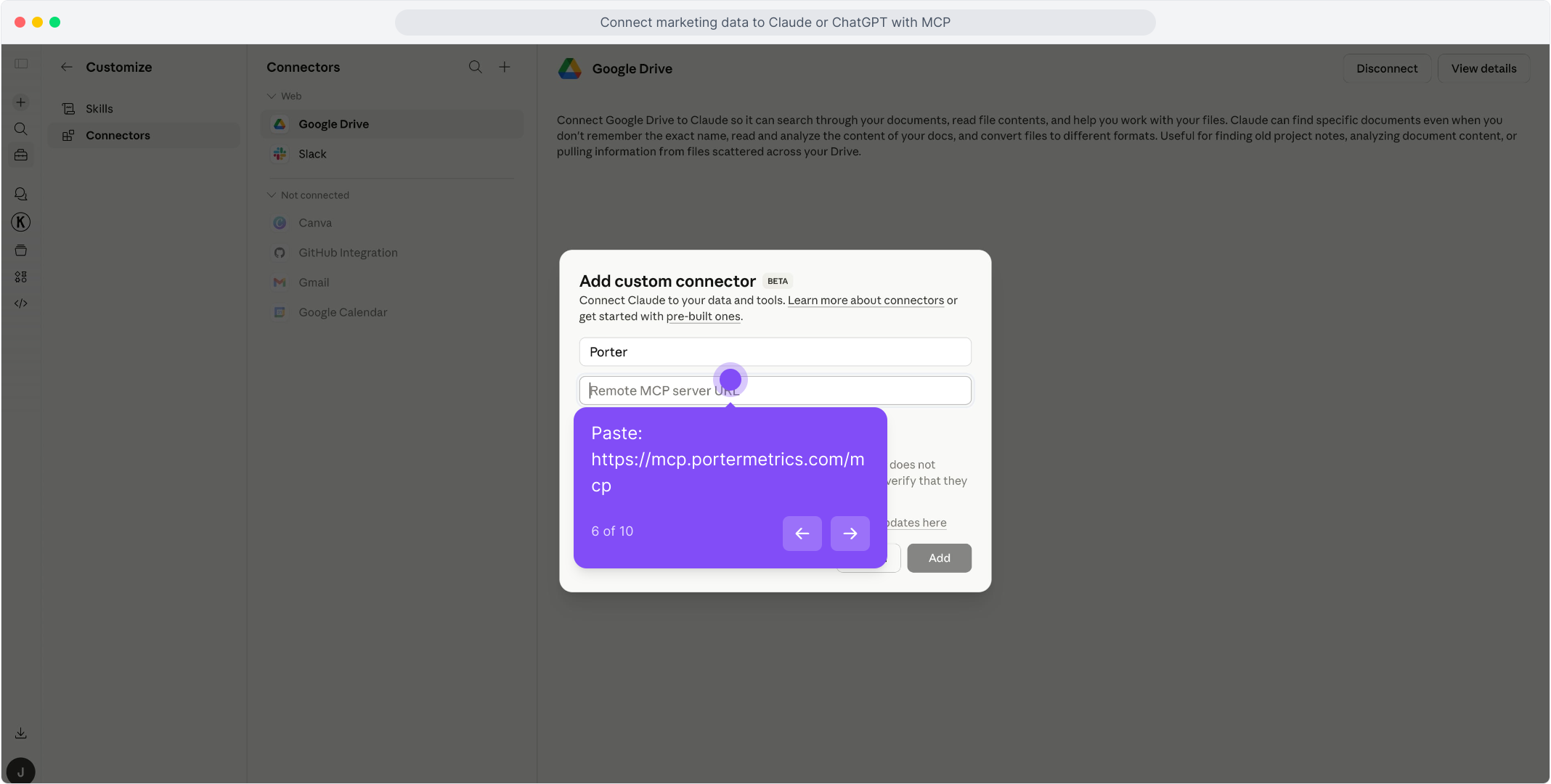
    In Claude, open Customize, then Connectors, and choose + Add, then Add custom connector. Name it Porter and paste this URL:

    MCP URL
    https://mcp.portermetrics.com/mcp
  3. Step 3: Ask Claude about Amazon Vendor Central

    Sign in to Porter, then try:

    Prompt
    Using Amazon Vendor Central, show shipped units and shipped revenue for the last 3 days Amazon has published, Manufacturing view.
app.portermetrics.com / create

Create: Amazon Vendor Central to Claude

Marketplace, then approve in Vendor Central

Select the vendor account Claude can use.

Porter's MCP URL pasted into the Remote MCP server field of Claude's custom connector dialog

Claude

Using Porter / Amazon Vendor Central …

Demo data
02Use cases and prompts

What you can ask Claude

Each use case comes with a prompt to copy, the fields it uses from the Amazon Vendor Central fields list and who it's for. Amazon publishes each day of vendor sales about three days later, so the daily prompts ask for the days Amazon has published, not for yesterday.

Which ASINs bring in the most shipped revenue?

The problemThe sales report in Vendor Central is downloaded and pivoted by hand every week to see which ASINs carry the business.

What Claude doesClaude reads Shipped Revenue, Shipped COGS and Shipped Units by ASIN from the Manufacturing view, day by day, up to the last day Amazon has published.

What you getA ranked list of ASINs with what they shipped and the gap between shipped revenue and shipped COGS.

Prompt
Using Amazon Vendor Central, Manufacturing view, list the 20 ASINs with the highest shipped revenue over the last 30 days Amazon has published, with shipped units, shipped COGS and shipped revenue minus shipped COGS. Tell me the last day included.

For: vendor managers · ecommerce managers · agencies

Fields used: ASINDateShipped revenue (Manufacturing)Shipped COGS (Manufacturing)Shipped units (Manufacturing)

Are ordered units turning into shipments?

The problemCustomers keep ordering, and nobody sees which ASINs ship well below what was ordered until the weekly review.

What Claude doesClaude puts Ordered Units next to Shipped Units by ASIN and week. Ordered units exist only in the Manufacturing view: Amazon does not send them in Sourcing.

What you getThe ASINs where orders and shipments drift apart, before they show up in the monthly numbers.

Prompt
For the last 4 weeks Amazon has published, Manufacturing view, compare ordered units with shipped units by ASIN and week. List the ASINs where ordered units exceed shipped units by more than 20%.

For: vendor managers · supply planners

Fields used: ASINDateOrdered units (Manufacturing)Shipped units (Manufacturing)

How are today's sales going, hour by hour?

The problemThe daily report arrives three days late, which is too late to react to a promotion or a deal that started this morning.

What Claude doesClaude reads Ordered Units and Ordered Revenue per ASIN and UTC hour, up to the last hour Amazon has published. Cancellations come as negative units, so the hours add up.

What you getToday's curve and the ASINs that lead it, while the day is still running.

Prompt
Show today's Amazon Vendor Central hourly sales in UTC: ordered units and ordered revenue per hour, up to the last hour Amazon has published, and the 10 ASINs with the most ordered revenue so far. Treat negative units as cancellations.
Then ask
Prompt
Compare today's ordered revenue up to the same hour with the same weekday last week.

For: vendor managers · performance marketers

Fields used: Date (UTC)Date + hour (UTC)ASINOrdered units (hourly)Ordered revenue (hourly)

Which ASINs do customers return the most?

The problemReturns hide inside the sales report, and a product with a quality problem keeps receiving traffic.

What Claude doesClaude totals Customer Returns by ASIN and sets them next to Shipped Units, so the return rate is returns divided by shipped units.

What you getA short list of ASINs to review with your category team, ranked by return rate.

Prompt
For the last 60 days Amazon has published, Manufacturing view, list the ASINs with the most customer returns, with shipped units and the return rate as customer returns divided by shipped units. Flag every ASIN above 10%.

For: vendor managers · category managers

Fields used: ASINDateCustomer returns (Manufacturing)Shipped units (Manufacturing)

How does the Sourcing view compare?

The problemVendor Central shows two views of the same sales, Manufacturing and Sourcing, and their totals don't always agree.

What Claude doesClaude reads each view from its own table: every metric carries the view in its name, so a Sourcing question is never answered with Manufacturing numbers. Sourcing has shipped revenue, shipped COGS, shipped units and returns, without ordered metrics.

What you getBoth views side by side, ASIN by ASIN, with the differences in plain sight.

Prompt
For the last 14 days Amazon has published, show shipped revenue and shipped units by ASIN in the Manufacturing view, then in the Sourcing view, and list the ASINs where the two views differ the most.

For: vendor managers · finance teams

Fields used: ASINDateShipped revenue (Manufacturing)Shipped revenue (Sourcing)Shipped units (Manufacturing)Shipped units (Sourcing)
03Why Porter

Why Porter for Amazon Vendor Central in Claude

Porter puts your Vendor Central sales in the same Claude connector as your ad, analytics and ecommerce sources, so a question about sales can include the campaigns that drove them. Porter only reads Amazon's sales reports: nothing in your Vendor Central account changes.

✓

Amazon's delay, stated

Amazon publishes a day of vendor sales about three days later. Porter reads up to the last published day and says so, instead of returning empty recent days that look like zero sales.

⊞

Vendor Central next to your ads

Ask about Vendor Central sales next to Meta Ads, Google Ads, GA4 and other sources from all Claude connectors in the same chat, through one Porter URL, with ASIN and date as clean keys.

⚙

Read-only, nothing changes

Claude reads sales reports. It cannot change a purchase order, a price or a product, and you can remove Porter's authorization in Vendor Central at any time.

Aa

17 ready-made fields

Claude gets 17 named Vendor Central fields in 3 groups: daily sales in the Manufacturing and Sourcing views and hourly sales, each with its definition.

↻

One URL, nothing to host

Approve Porter in Vendor Central and add one MCP URL to Claude. There is no report to download, no export to schedule and no warehouse to keep in sync.

✓

Live dashboards, not only chat answers

Ask Claude for a dashboard and Porter's AI dashboards publish it at its own link, synced automatically and ready to share.

04Dashboard

Dashboard template

Ask Claude to build a live Amazon Vendor Central dashboard with AI dashboards, or browse Porter's templates for other sources.

AI dashboards

Build a live Amazon Vendor Central dashboard from the chat

Describe the dashboard in one sentence and Porter builds it. A client-ready dashboard in minutes, with no chart dragging and no BI tool to learn. Ask Claude:

Prompt
Build a live Amazon Vendor Central dashboard for my vendor account with the last 30 days Amazon has published: shipped revenue, shipped units, ordered units and customer returns, with a weekly trend and the top ASINs.
Live URLEach dashboard at its own link: no login, no app, no download
Auto-syncFresh Vendor Central data, nobody re-exports each period
Scheduled deliveryEmail or PDF sends on a set day
White labelYour logo and branding for clients
Sharing permissionsView or edit access per person

Or start from a template

05Pricing

Pricing

You can start free, since Porter’s Amazon Vendor Central connector for Claude comes with every plan. Use the calculator for your number of accounts, or see Porter pricing for every plan.

What you get

  • Free plan: never expires, with unlimited connected accounts and the last 15 days of data in Claude (30 days in Data Studio and Sheets)
  • Reporting: from $12.50 per account a month billed annually, or $15 month to month for one account
  • Billing: each Vendor Central connection, one vendor in one marketplace, counts as one account, with volume discounts and no per-seat fee
  • No credits needed: Claude's Vendor Central questions are reads, so they use no AI credits
  • Trial: 14 days of full access, no card

Price calculator

$33.33/mo$6.67 per account

An account is one ad account, Stripe account, store, page or GA4 property. The Free plan never expires and has unlimited accounts, with the last 15 days of data in AI chats.

06Data and actions

Amazon Vendor Central data Claude can use

Claude reads Amazon Vendor Central as three tables: daily sales in the Manufacturing view, daily sales in the Sourcing view and hourly sales, with all 17 fields in the Amazon Vendor Central fields list. Each metric carries its table in its name, so one question reads one table: daily and hourly metrics, or Manufacturing and Sourcing metrics, are asked for separately.

12 Amazon Vendor Central fields Claude uses most

FieldWhat it's for
ASINamazon_vendor_asinThe product, exactly as the report gives it
Dateamazon_vendor_dateDay of the daily sales row
Currencyamazon_vendor_currency_codeCurrency of the amounts in the row
Ordered revenue (Manufacturing)amazon_vendor_manufacturing_ordered_revenueWhat customers paid for the units ordered that day
Ordered units (Manufacturing)amazon_vendor_manufacturing_ordered_unitsUnits ordered that day; Manufacturing view only
Shipped revenue (Manufacturing)amazon_vendor_manufacturing_shipped_revenueRevenue of the units shipped that day
Shipped COGS (Manufacturing)amazon_vendor_manufacturing_shipped_cogsCost of goods sold of the units shipped
Shipped units (Manufacturing)amazon_vendor_manufacturing_shipped_unitsUnits shipped to customers that day
Customer returns (Manufacturing)amazon_vendor_manufacturing_customer_returnsUnits customers returned that day
Shipped revenue (Sourcing)amazon_vendor_sourcing_shipped_revenueThe same, in the Sourcing view
Ordered units (hourly)amazon_vendor_hourly_ordered_unitsUnits ordered in the hour; negative when cancellations win
Date + hour (UTC)amazon_vendor_hour_start_utcStart of the hour, UTC; only closed hours

Product stats

WhatAmazon Vendor Central connector
Fields17 in 3 groups: 5 dimensions and 12 metrics
TablesDaily sales (Manufacturing), daily sales (Sourcing) and hourly sales, all by ASIN
FreshnessDaily sales up to the last day Amazon has published, about 3 days back; hourly sales up to the last published hour
HistoryDaily sales: one year back. Hourly sales: the last 29 days
ActionsReads only; your Vendor Central account stays as you set it
SpeedAmazon serves daily sales in reports of at most 15 days, so a year is 25 reports read one after another; the first long question takes a while
AccessAmazon's Selling Partner API authorization; one vendor in one marketplace per connection
Not includedTraffic (glance views), inventory and purchase orders

See all 17 Amazon Vendor Central fields

07Security

Is it safe?

Yes. Porter's Amazon Vendor Central connector for Claude only reads sales reports, through the authorization you approve on Vendor Central. Purchase orders, prices and products stay exactly as you set them.

Amazon's own authorization

You approve Porter on Amazon's Vendor Central consent page, through the Selling Partner API. You never give Porter a password or a key, and you can remove the authorization in Vendor Central at any time.

Sales reports, nothing else

Porter asks Amazon only for vendor sales reports, by day and by hour. Claude queries Porter, not Amazon directly, and Porter waits and retries when Amazon throttles report requests.

What the connector needs from Amazon

Your approval on Vendor Central for one marketplace. Each approval connects one vendor in one marketplace; to read another marketplace, connect it on its own.

08FAQ

FAQ

Before connecting Amazon Vendor Central to Claude through Porter, vendor teams usually ask about marketplaces, the two views, time zones and other AI tools. After those come 4 fixes: missing recent days, totals that don't match the account total, negative hourly units and a slow first question.

Can I connect several marketplaces or vendor accounts?

Yes. Each connection is one vendor in one marketplace, and Porter offers all 23 Vendor Central marketplaces. Connect each one on its own; each bills as one data source account, and you name the one you mean when you ask.

What is the difference between the Manufacturing and Sourcing views?

They are the two views Vendor Central gives of your sales, and Porter keeps each in its own table. Manufacturing has ordered revenue and ordered units; Sourcing does not, because Amazon does not send them in that view. Shipped revenue, shipped COGS, shipped units and customer returns exist in both.

Which time zone do the dates use?

Hourly sales are in UTC, and Date (UTC) is the UTC day of each hour. The daily reports carry a date without a time, and Amazon does not say which time zone closes that day, so a daily date and a UTC date are not the same day.

Does Porter's Amazon Vendor Central connection work in other AI tools?

Yes. The same Porter account and connection work in any AI tool that supports MCP, with the same vendor account and fields.

Troubleshooting

Why are the last days missing from the daily sales?

Amazon publishes a day of vendor sales about three days later: on October 29, 2026 at 11:00 UTC the last day available was October 26. Porter reads up to the last day Amazon has published and says where it stopped, instead of returning empty days that look like zero sales. For today, ask for hourly sales.

Why doesn't the sum of the ASINs match the account total?

Amazon's report carries its own account total, and for shipped revenue and shipped COGS it does not always match the sum of the ASINs to the cent: it differed on 7 of 15 days measured in the Manufacturing view. Porter publishes the rows by ASIN, so the totals Claude gives are the sum of the ASINs.

Why are some hourly units negative?

An hour where cancellations outnumber new orders comes back negative from Amazon. Porter keeps those rows so the hours add up to the real total, so treat them as cancellations rather than errors.

Why is the first long question slow?

Amazon serves daily vendor sales in reports of at most 15 days and builds each report before Porter can read it, so a year of daily sales is 25 reports read one after another. Hourly sales go back 29 days at most, in reports of 7 days. Shorter ranges answer faster.

09Next

More Claude connectors

Vendor Central sales make more sense next to the campaigns and traffic behind them, and Porter brings each of those sources in through the same MCP URL. Add the ones you report on, or browse all Claude connectors:

Not only Claude

The same Porter account and connection work in any AI tool that supports MCP, at no extra cost.

Try it on your own vendor account

Connect Amazon Vendor Central to Claude through Porter and ask which ASINs shipped the most, how today is selling and what customers return. Setup takes one approval on Vendor Central, and the free plan includes the Amazon Vendor Central connector for Claude.

Free plan · 14-day trial · No card needed

Vendor managers: shipped revenue, COGS and units by ASIN from one question.

Supply planners: ordered against shipped units, ASIN by ASIN.

Performance marketers: today's sales hour by hour, while a deal is running.