







To connect Mailchimp to ChatGPT:
- Sign up free at portermetrics.com and connect your Mailchimp account with your Mailchimp account.
- In ChatGPT, click + → Connectors → Manage connectors → Add custom connector, name it Porter, paste
https://mcp.portermetrics.com/mcp, then click Add and authenticate with Google.
That’s it, you’re connected. Porter’s free plan covers up to 3 Mailchimp audiences with no usage limits on ChatGPT’s free plan. No credit card required.
What makes Porter different:
- 204+ Mailchimp metrics and dimensions, across every reporting level in one connection.
- Universal Mailchimp MCP. Hosted white-label dashboards and client portals, competitor email tracking with engagement analysis, list health monitoring with automated alerts. Your whole Mailchimp operation runs from one chat.
Prerequisites
- A Porter Metrics account with your Mailchimp account connected (free tier is enough to try it end-to-end)
- A ChatGPT account — the free plan works for ChatGPT Web; a Pro subscription is needed for Codex and Desktop MCP features
- Admin or standard access to the Mailchimp audiences you want to connect
Connect Mailchimp to ChatGPT with MCP
For this tutorial we’re going with the MCP method. Here’s a quick explainer of what MCP is and why it’s the best path for Mailchimp.
MCP (Model Context Protocol) is the open standard that lets AI tools like Claude, ChatGPT, Codex and others access and use external APIs — the things that make tools like Mailchimp work under the hood. Instead of building a custom integration for every AI tool you use, you install one MCP and every compatible AI gets access to the same data.
The full setup takes under 5 minutes and breaks into three moves: connect Mailchimp to Porter, point ChatGPT at the Porter MCP, and ask your first question.
1. Connect your Mailchimp data to Porter
Porter sits between Mailchimp (Intuit)’s Marketing API and ChatGPT. It handles OAuth, rate limiting, pagination and all the plumbing so ChatGPT only ever sees clean, structured data.
Sign up for Porter. Create a free account at portermetrics.com. The free tier is enough to run this full workflow end-to-end.
Connect your Mailchimp. In Porter, click Create → pick ChatGPT as the destination → select Mailchimp as the source → sign in with Mailchimp to grant access to your audiences.
Select your audiences. Choose the Mailchimp audiences you want ChatGPT to query. When you select multiple audiences under a single connection, Porter automatically blends their data together so you can query them as one.
Optional: enable automatic BigQuery storage if you’re connecting multiple audiences with large data volumes. This keeps ChatGPT’s responses fast even at scale.
2. Connect the MCP to ChatGPT
Porter’s MCP URL is what you paste into ChatGPT. Once added, ChatGPT can query Mailchimp data on demand in any conversation.
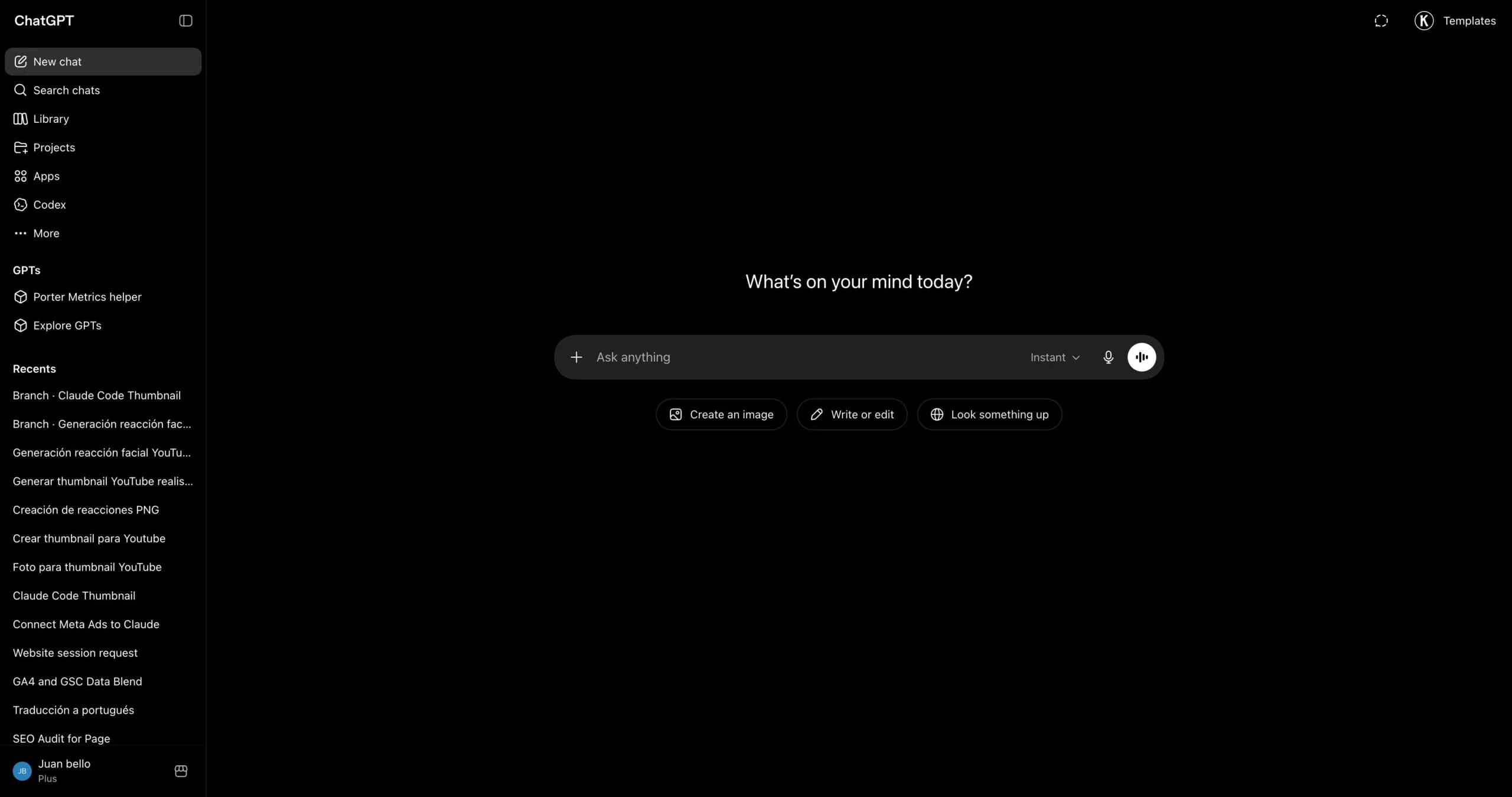
Go to chatgpt.com and click the + icon in the chat input to open the tools menu.
In the menu that opens, hover over Connectors and click Manage connectors.
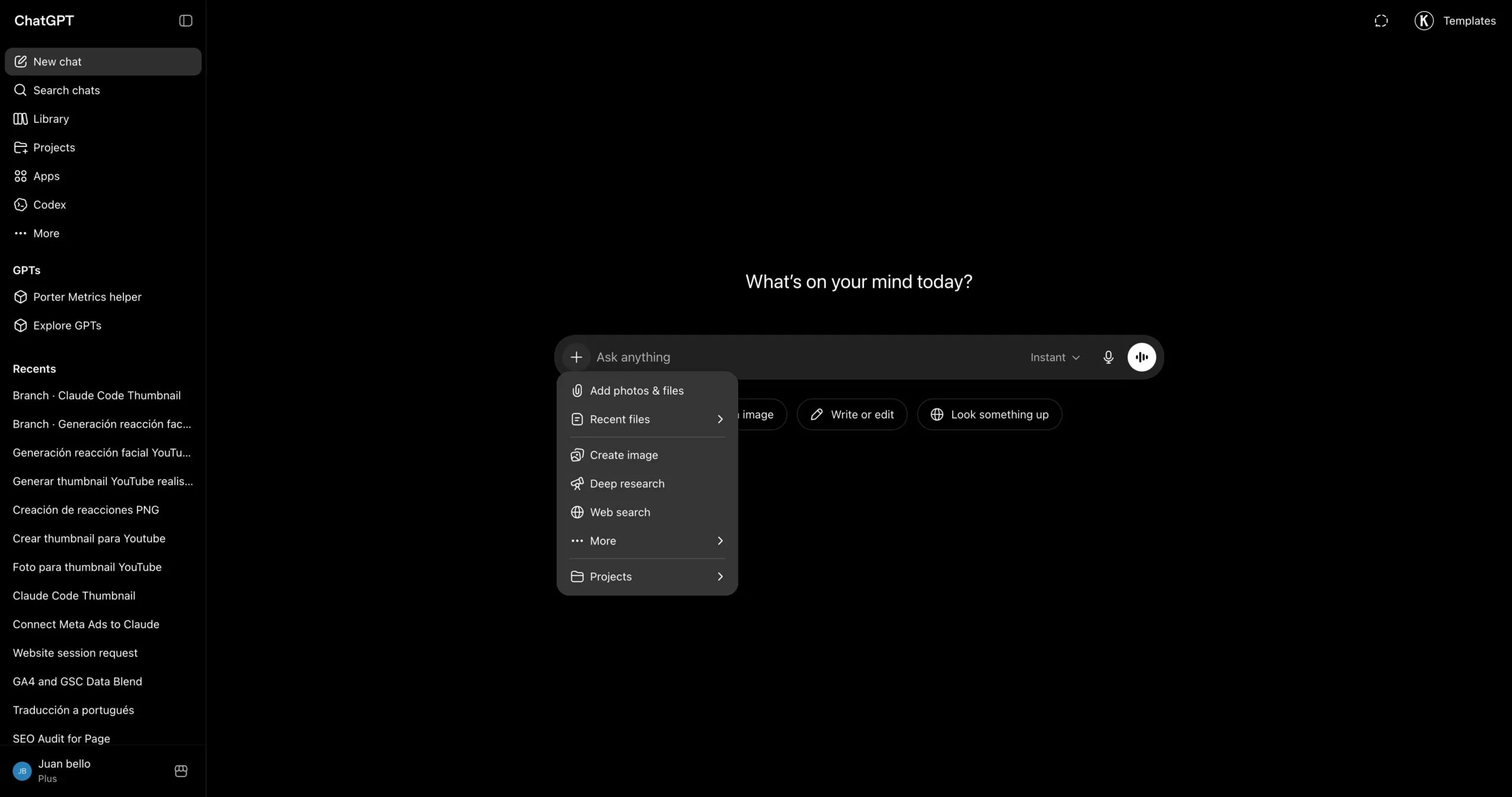
In the Connectors panel, click the + button at the top of the list to start adding a new connector.
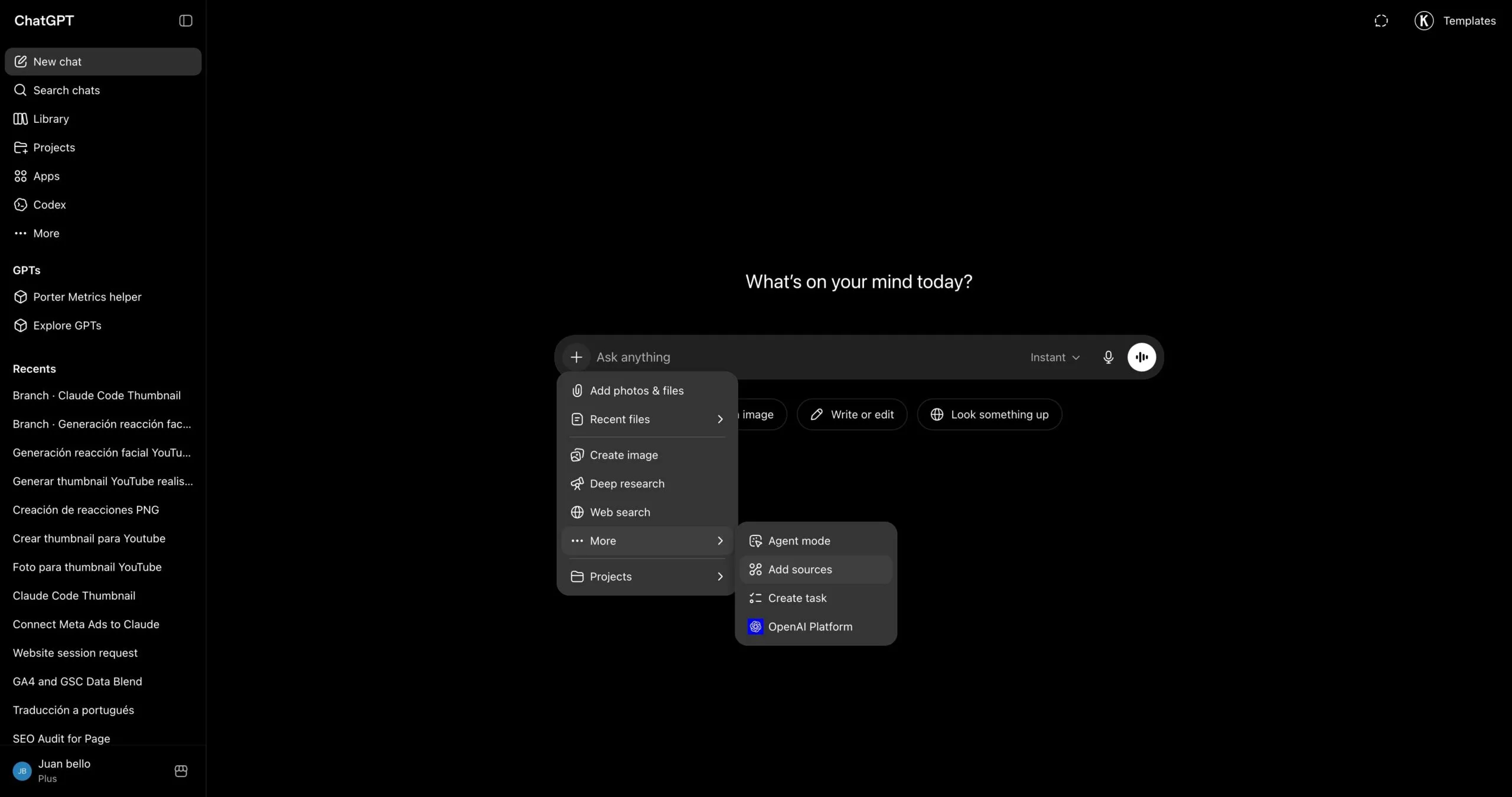
Pick Add custom connector from the dropdown that appears.
A dialog opens with the name and URL fields. Type Porter in the first field to name the connector.
In the second field, paste https://mcp.portermetrics.com/mcp. Leave the advanced settings alone.
Click Add at the bottom right of the dialog. ChatGPT opens a sign-in window — use the same Google account linked to your Porter workspace and approve access.
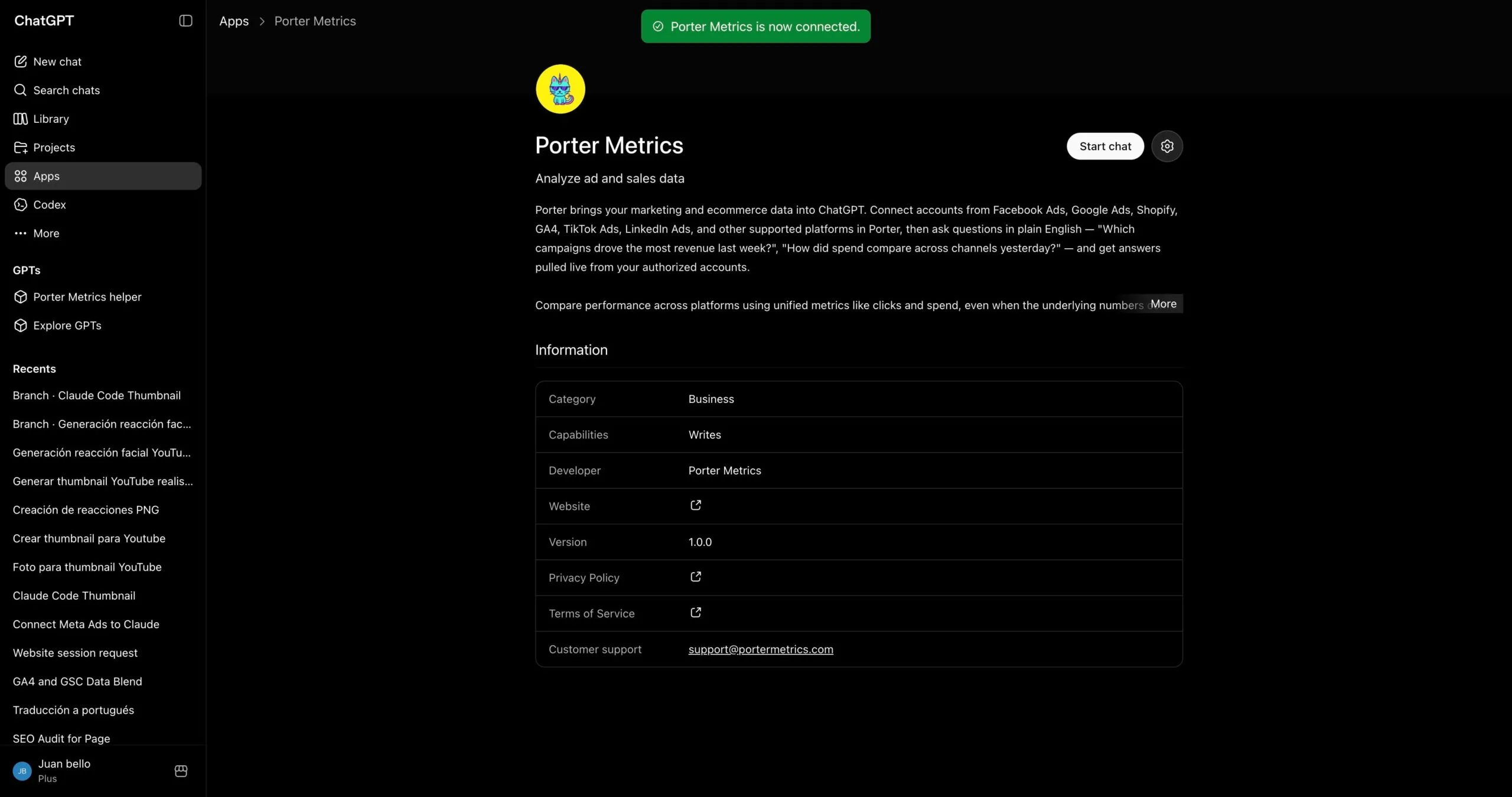
Once the authorization finishes, you’ll see Porter’s tools appear in the connectors panel. You’re ready to start asking questions (and, for connectors that support it, running actions).
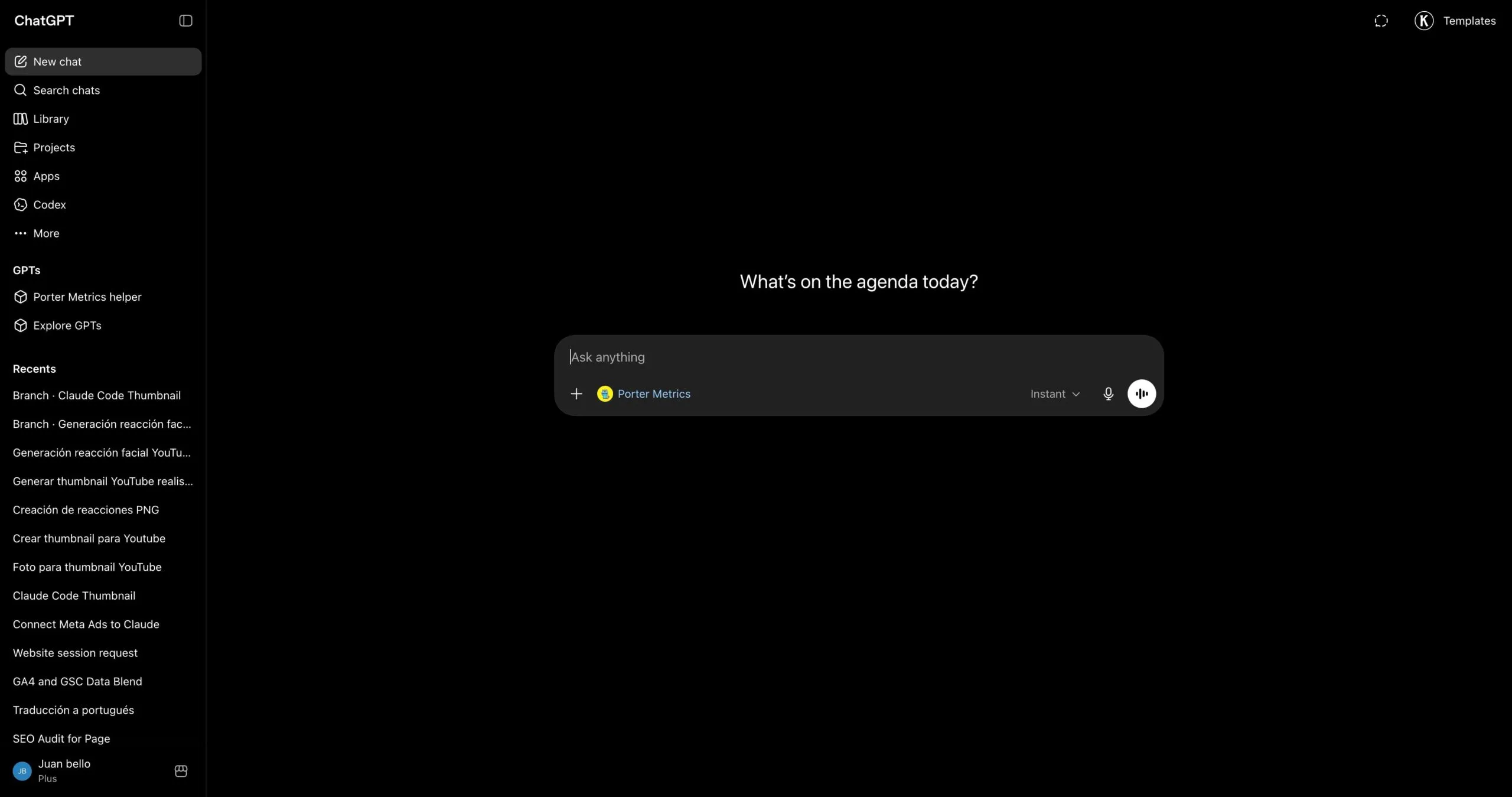
For a fuller walkthrough with screenshots at every step, see the Porter MCP tutorial.
3. Start building questions and dashboards
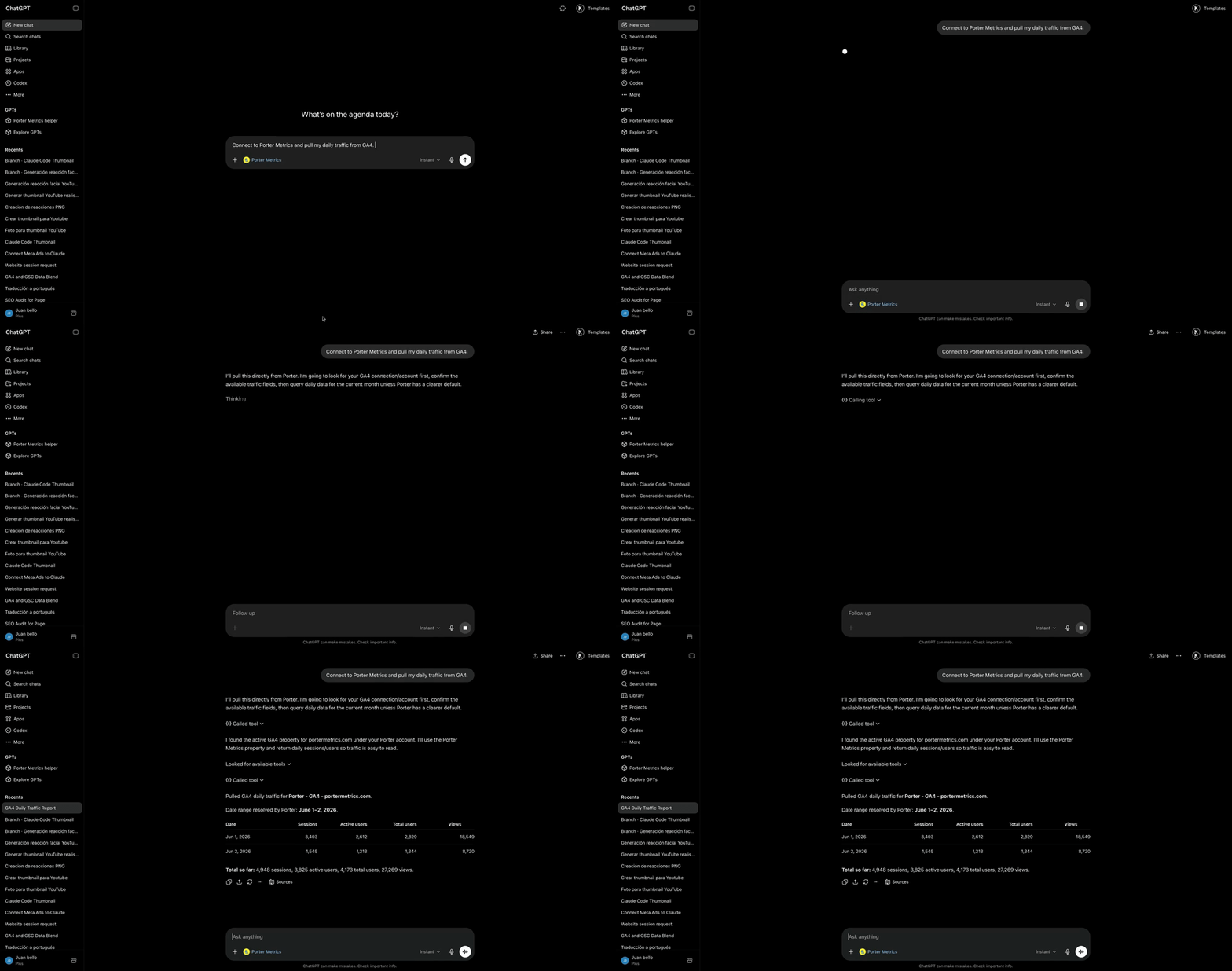
With Porter connected, open a new ChatGPT chat and ask anything about your Mailchimp in plain English. ChatGPT calls Porter behind the scenes, pulls live data from Mailchimp (Intuit), and answers with tables, charts, or summaries.
Try one of these to verify the setup is working:
For a full catalogue of copy-paste prompts organized by use case (performance, deliverability, client reporting, agency, e-commerce, cross-channel), jump to the prompts section below.
Alternative ways to connect Mailchimp to ChatGPT
Porter MCP is the path we just walked through and the one we recommend for most marketers. It is not the only way to get Mailchimp data in front of ChatGPT, though. The most common alternatives are Mailchimp’s direct API, a live Google Sheets bridge or CSV upload, and BigQuery for scale. Each has trade-offs, so pick the one that fits how your team already works.
- 🔌 Mailchimp’s direct API — Talk to Mailchimp (Intuit)’s Marketing API yourself. Maximum control, but you handle auth, rate limits and pagination — and you only get one source. (Mailchimp doesn’t ship an official MCP yet.)
- 📊 Google Sheets — Live Sheet or one-off CSV upload. Auditable, familiar, faster for big exports — but aggregation happens in the Sheet, not the API.
- 🗄️ Google BigQuery — For large audiences or agencies running multi-audience analysis. BigQuery aggregates; ChatGPT only queries pre-built summaries.
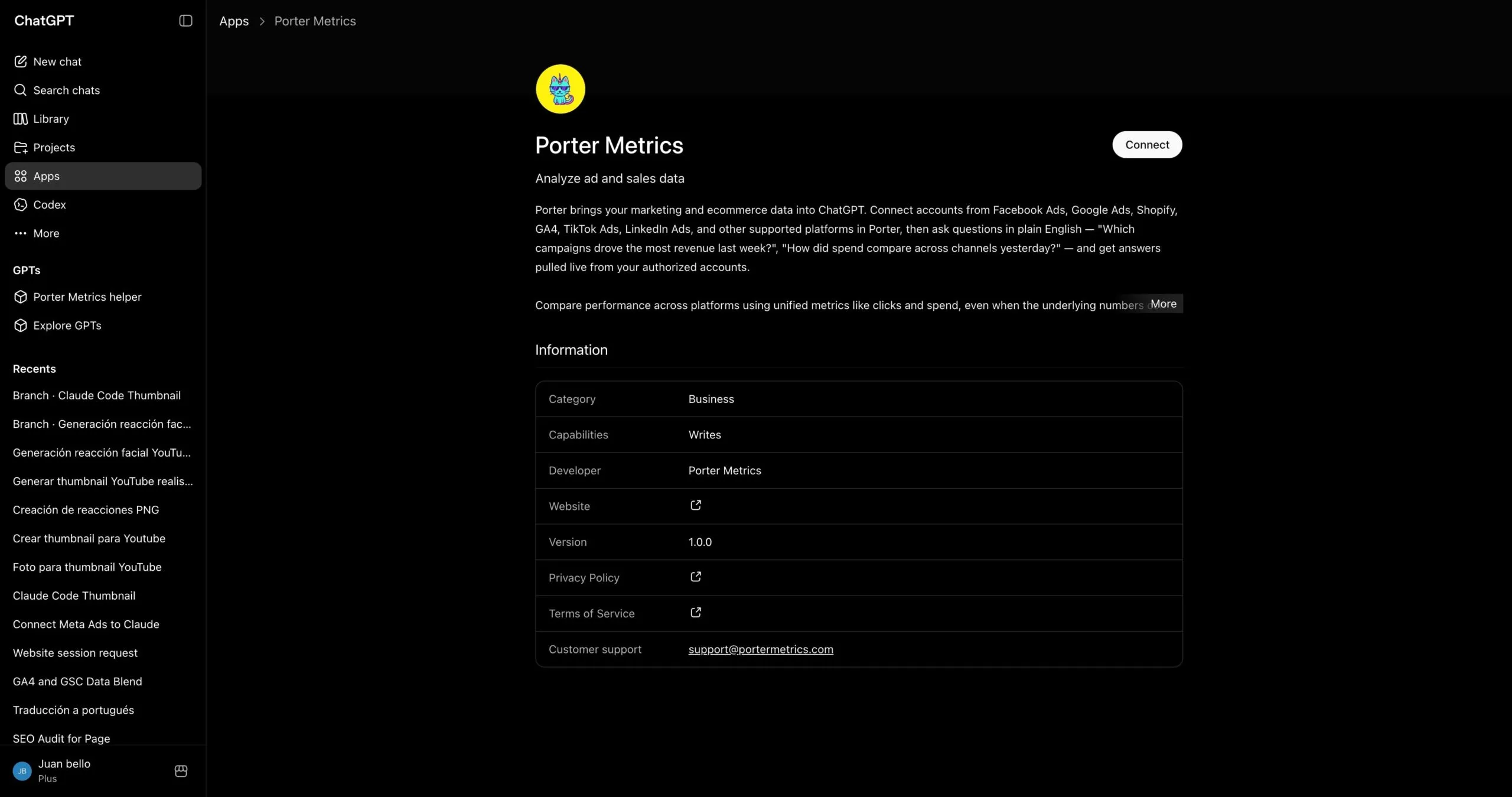
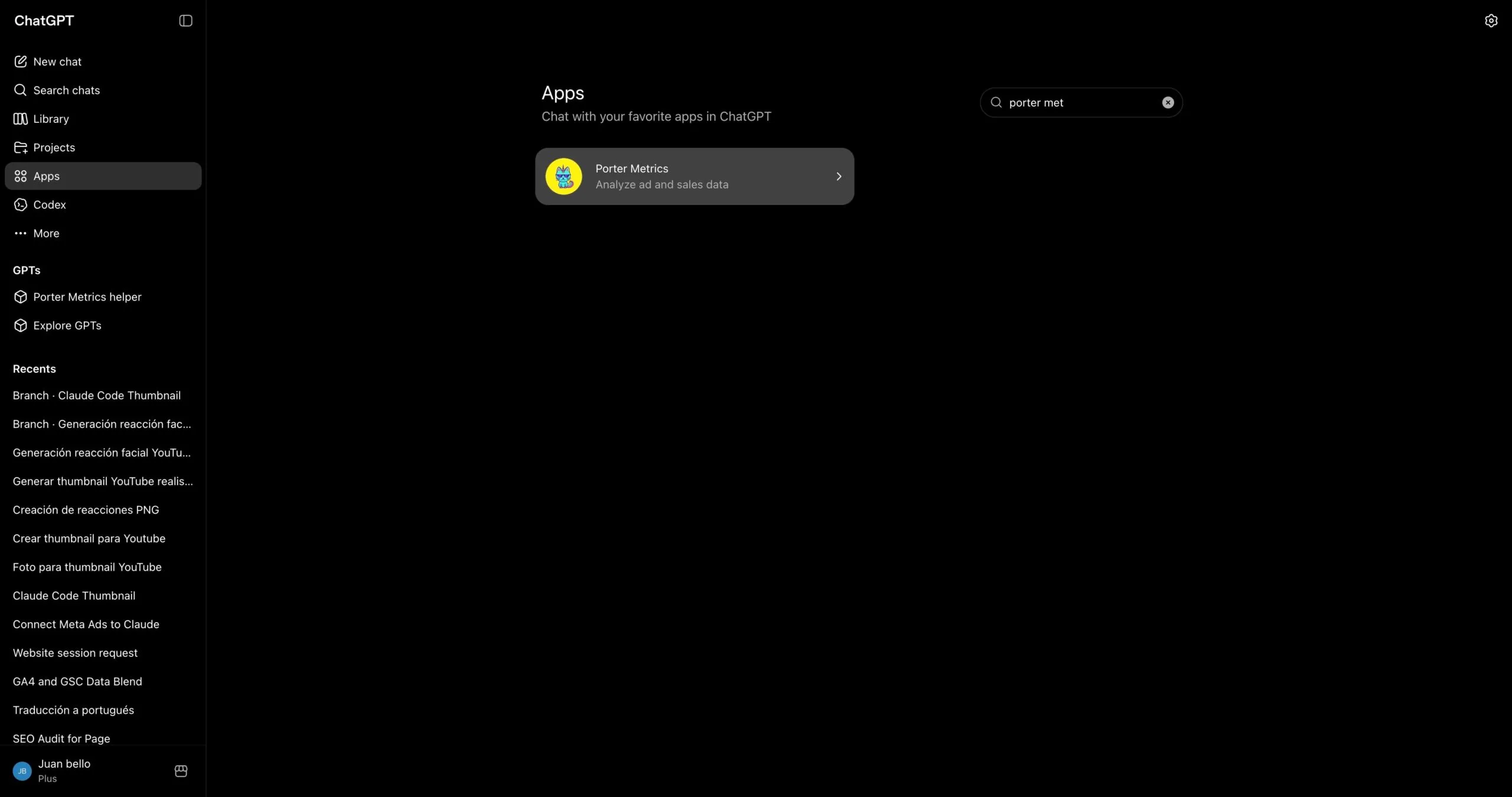
Via the Porter Metrics app in the ChatGPT marketplace
If you’d rather not paste a connector URL, install Porter straight from ChatGPT’s app gallery — it’s the same Porter connection behind the scenes, published as an approved ChatGPT app:
- Open the Porter Metrics app page in ChatGPT (or search “Porter Metrics” in the apps gallery).
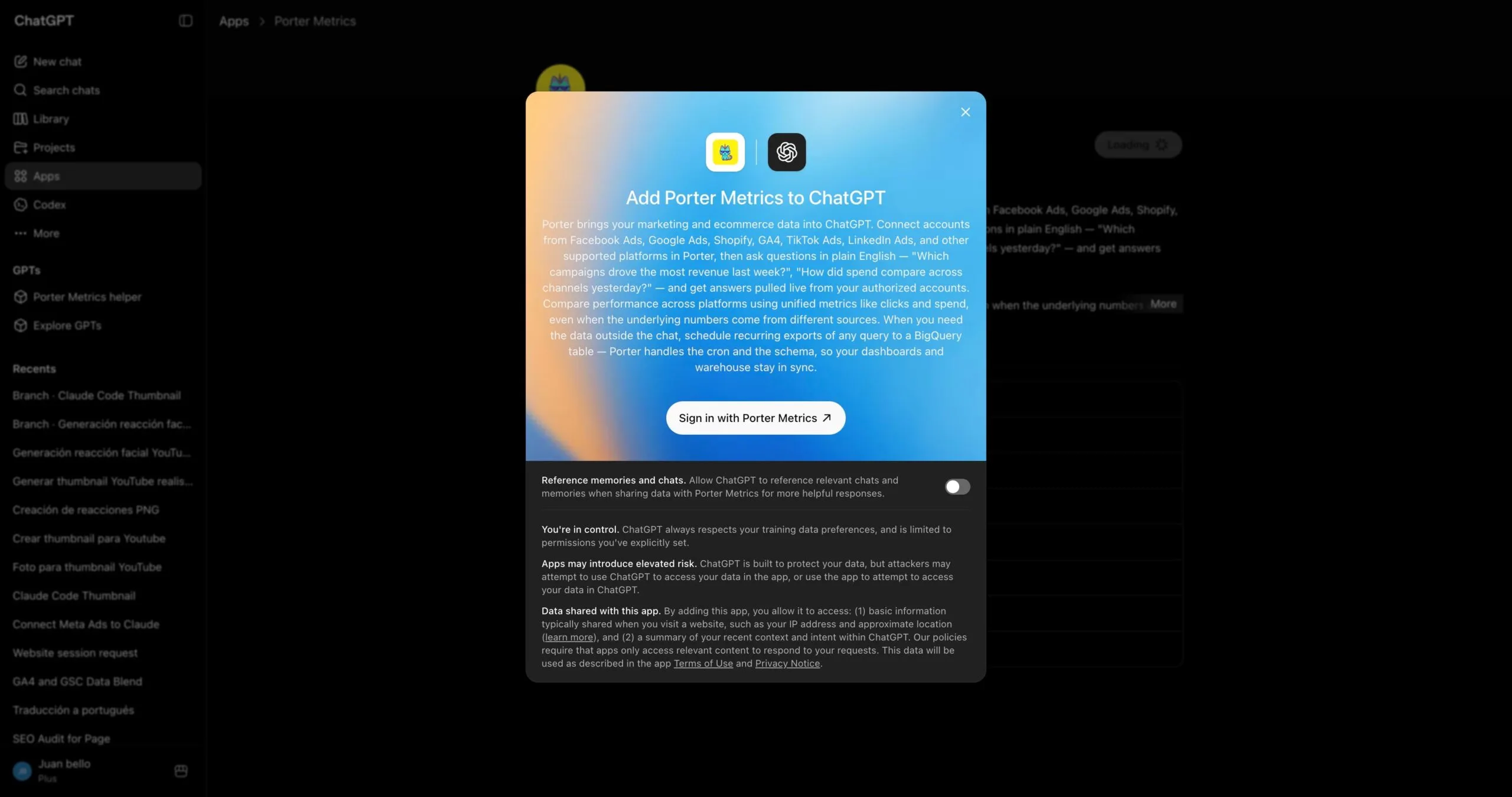
- Click Connect and sign in with the same account you use in Porter.
- Authorize it and ask your first Mailchimp question — same live data as the MCP.
The trade-off to know: the marketplace app only updates after each ChatGPT review cycle, while the MCP updates the moment Porter ships. If you want every new tool and data source immediately, use the MCP; if you want the one-click install and don’t mind waiting for new features, the marketplace app is the shortest path — including write actions through your connected Porter account.
Via Mailchimp’s direct API
If you’re building a product around Mailchimp — or you’re a developer who’d rather own every layer of the integration — the most direct path is talking to Mailchimp (Intuit)’s Marketing API yourself, or — where it exists — Mailchimp’s own official MCP. Mailchimp doesn’t ship an official MCP as of June 2026. Intuit/Mailchimp does publish an official MCP for Mailchimp Transactional (Mandrill) messaging only, but this is strictly a transactional-email developer tool and does not expose audiences, campaigns, reports, or any marketing analytics data. Whichever route you pick, you still follow Mailchimp (Intuit)’s rate limits & quotas. Either way you skip Porter and call Mailchimp (Intuit) from your own code, from Codex, or from Mailchimp’s own connector.
The trade-off to know. Going direct gives you maximum control and the freshest possible data — every endpoint, every parameter, no abstraction layer in between. But you’re now responsible for OAuth flows, refresh tokens, rate limits, pagination, schema changes, and error retries. And critically, you only get one source. The moment you also want Google Ads, GA4 or Shopify in the same conversation, you’re back to building (or stitching together) more integrations.
When this makes sense: engineering teams that need a single source with full control, products that ship Mailchimp data as a feature (where you own the integration anyway), or one-off scripts where you don’t mind writing the auth and pagination code yourself. For marketers who want to ask questions in plain English and blend Mailchimp with the rest of their stack in a single conversation, the Porter MCP path is dramatically less work.
Via Google Sheets (live Sheet or manual CSV)
If your team already lives in Google Sheets — or you want a paper trail before ChatGPT touches anything — feed Mailchimp into a Sheet, then let ChatGPT read the Sheet. You can automate the Mailchimp → Sheets pipeline with Porter so it refreshes daily, or do one-off CSV exports from Mailchimp’s native UI for static analysis.
The trade-off to know. With the MCP path, ChatGPT calls Mailchimp (Intuit)’s API directly and Mailchimp (Intuit) does the filtering and aggregation on its side — clean and deterministic. With the Sheets path, ChatGPT aggregates inside the Sheet itself, which can introduce hallucinations on totals, averages, and joins when you have thousands of rows. The upside is speed: for very large date ranges or historical analysis, a pre-built Sheet is dramatically faster than live API calls.
When this makes sense: finance teams that want to review numbers before ChatGPT acts on them, agencies already delivering client reports in Sheets, historical analysis across years of data, or any case where you care more about speed than real-time freshness.
Read the full Sheets tutorial →
Via Google BigQuery (for scale)
This is the path most people overlook — and it’s the one that saves you when your Mailchimp audience gets serious. A single large subscriber or an agency managing 10+ audiences will hit API rate limits and latency problems querying ChatGPT directly. ChatGPT will literally tell you it’s taking too long or timing out on big pulls.
BigQuery fixes that. You load Mailchimp data into BigQuery tables on a schedule, then connect BigQuery to ChatGPT — either through a BigQuery MCP or via Codex with SQL queries. Instead of asking ChatGPT to pull raw Mailchimp data, you let BigQuery aggregate into small, optimized tables, and ChatGPT only queries the summarized output. Scale problem solved.
When this makes sense: enterprise audiences with thousands of subscribers, agencies running multi-audience analysis across 10+ clients, or any team already using BigQuery as a data warehouse. Porter loads Mailchimp (and 25+ other sources) directly into BigQuery so you don’t have to build your own ETL.
Read the full BigQuery tutorial →
Connecting Mailchimp to Codex
Most marketers lump ChatGPT and Codex together and miss the biggest advantage of the entire MCP ecosystem. They’re not the same tool — and the difference matters enormously once you start working with Mailchimp data seriously.
ChatGPT is a chat interface. You ask a question, ChatGPT pulls live data through the MCP, answers, maybe builds a quick dashboard inside the conversation. Great for one-off analysis. The problem: everything is ephemeral. Want to refresh the dashboard tomorrow? You regenerate it from scratch. Want the same report every Monday? You re-ask the question every Monday.
Codex is ChatGPT running inside your computer’s terminal. Because it has access to your filesystem, runtime, and other developer tools, it doesn’t just answer questions — it can build real software. Persistent scripts, scheduled routines, HTML apps, internal dashboards, integrations that run 24/7 without your input. Once it’s connected to Porter’s MCP for Mailchimp, a whole category of work becomes possible.
What Codex unlocks that ChatGPT alone cannot
This is where the MCP ecosystem pays off most. Because Codex can combine Porter’s MCP with other MCPs — Firecrawl for web scraping, Airtable for structured data, Notion for wikis, Vercel for deployment, Slack and Gmail for delivery — you’re no longer querying data. You’re building tools.
Feed Codex your Mailchimp targets and goals — open rate thresholds, bounce rate limits, list growth targets — and ask it to generate a custom email performance dashboard for each client. It builds the HTML, pulls live data, deploys to a URL. No Data Studio embed to break when the vendor changes pricing, no template constraints. The dashboard updates automatically because it queries Porter’s MCP on every page load.
Best for:agencies that want white-label client dashboards without Looker or Data Studio dependencies.
Combine your own Mailchimp performance from Porter with competitor email campaigns and subject lines scraped via Firecrawl. Codex stitches both into a weekly competitive intelligence report — your numbers next to their send frequency and engagement rates, with an LLM summary on top of what changed week over week. Runs on cron, lands in your inbox every Monday morning.
Best for:in-house teams that need market context, not just internal numbers.
Use Airtable or Notion as the schema, Porter as the data source. Codex keeps every page populated with current open rate, click rate, and bounce rate for every audience — no stale screenshots, no copy-paste from Excel. New hires read one wiki entry and have full context on a client’s account.
Best for:agencies and ops teams onboarding analysts or rotating account managers frequently.
A Codex routine on cron pulls Mailchimp via Porter, evaluates thresholds — open rate drops below 15%, bounce rate spikes above 5% — and pushes Slack or Gmail alerts the moment something crosses the line. You stop checking dashboards reactively; the dashboard checks itself and tells you when to look.
Best for:any team that’s ever discovered a problem 48 hours too late because nobody opened the report.
Bottom line: ChatGPT is for quick questions and ad-hoc dashboards. Codex is for building apps, live dashboards, alerts, and actual tools — anything you want to run on its own without re-asking. Same Porter MCP URL works in both, so you don’t pick once and lock in.
Use cases: what you can actually do once Mailchimp is connected to ChatGPT
Getting the connection right is half the battle. The real value shows up in what you do next. Here are the use cases Porter users build around their Mailchimp data — from simple Q&A to full client-facing workflows.
1. Chat and ask questions directly
The simplest use case — and still the one 80% of marketers start with. Open ChatGPT, ask a question, get an answer grounded in live data.
It’s the fastest way to replace a daily Mailchimp reports check-in. But chat is table stakes — the interesting use cases come next.
2. Blend Mailchimp with your revenue data (Shopify, Stripe, HubSpot)
This is where a 360° view gets real. When you connect Mailchimp and your revenue source (Shopify for e-commerce revenue, Stripe for payment tracking, HubSpot for CRM pipeline), ChatGPT can map email campaigns to actual purchases and closed-won deals — using campaign names, send dates, and UTM parameters — and give you attribution that no platform-side number can.
ChatGPT handles the campaign names, send dates, and UTM parameters mapping and joins. You get a client-ready attribution report that no single platform can generate on its own.
3. Automated alerts and notifications on Slack or Gmail
With Codex you can turn Mailchimp monitoring into a routine that runs on its own. Hook Porter’s MCP (for the data) together with a Slack or Gmail MCP (for delivery), then write a Codex scheduled task that pulls performance every morning and pings you only when something actually needs attention.
No dashboards, no daily check-ins. The report comes to you — and only when it matters.
4. Client-ready presentations with live data (Gamma, HTML, PDF)
A common agency pain: you send clients a Data Studio link — and you spend an hour explaining a broken dashboard. With ChatGPT you can build the presentation itself — as a Gamma deck, a custom HTML page, or a PDF — populated with live numbers each time.
The presentation becomes a delivery artifact you send to the client, not a dashboard that depends on another tool staying up. No broken iframe, no login prompts, just the content.
Mailchimp fields and metrics you can query with ChatGPT
Before you start writing prompts, it helps to know what data is actually available. Porter MCP gives ChatGPT access to 204 Mailchimp fields and metrics across every reporting level, plus breakdowns by date, day of week, hour of day, month, quarter, week, year. And the same MCP URL also unlocks 25+ other sources — so ChatGPT can blend Mailchimp with Google Ads, GA4, Shopify, HubSpot and more in a single prompt.
Prompts you can copy-paste today
Use these prompts organized by job: performance checks, deliverability audit, client reporting, prompts for agencies managing multiple clients, prompts for e-commerce teams, and cross-channel blends.
1. Performance checks
Use these when you need a quick health check on campaigns, audiences, or engagement trends.
2. Deliverability audit
Use these when bounce rates spike or you need to audit sender reputation.
3. Client reporting
Use these when you need to generate client-ready summaries or presentations.
4. Prompts for agencies managing multiple clients
Use these when you’re running multi-audience or multi-client Mailchimp operations.
5. Prompts for e-commerce teams
Use these when you need to connect email performance to revenue and orders.
6. Cross-channel
Use these when you need to blend Mailchimp with other platforms for attribution and comparison.
Limits, safety, and best practices for Mailchimp via ChatGPT
This is the closest thing to a “ban story” for Mailchimp API usage: not an account ban, but a security breach caused by leaked or poorly secured API keys. In 2024, Mailchimp itself was targeted in phishing campaigns that exposed subscriber data from services like Have I Been Pwned. For marketers using Claude or MCP integrations, the real cost isn’t a suspended Mailchimp account — it’s exposing your entire audience database because an API key was hardcoded in a prompt, shared in a chat log, or stored without rotation. Unlike Meta Ads, where the fear is “will my ad account get banned?”, the Mailchimp risk is quieter but costlier: a single leaked key can export every email, tag, and segment you’ve ever collected.
Mailchimp’s enforcement is abuse-complaint-driven and quota-based, not tool-based. Mailchimp doesn’t ban accounts because you used Claude or an MCP. It throttles or suspends because of how the API was used: hitting the 10 concurrent connection limit, exceeding 20 message searches per minute, or triggering Omnivore’s abuse-prevention algorithm through high spam complaint rates. Read-only API calls for campaign metrics, audience lists, and engagement data are safe. Write-at-scale (bulk unsubscribes, mass campaign sends via API) or bursty parallel requests are not. The platform’s automated systems reward predictable, low-volume read patterns — exactly what an MCP-powered analysis workflow produces.
What actually goes wrong when scaling Mailchimp via ChatGPT
After reviewing official docs and community threads, two patterns come up again and again.
1. Leaking or misconfiguring API keys. Hardcoding a Mailchimp API key in a Claude prompt, sharing it in a team chat, or storing it in an unencrypted document exposes your entire audience database. In 2024, Mailchimp was the target of multiple phishing and API security incidents that exposed subscriber data at scale (approov.io, scworld.com). What to do instead: Use OAuth-based authentication where possible, rotate keys quarterly, and never paste API keys into LLM chat windows. Porter MCP handles key storage server-side — the key never touches your local prompt.
2. Exceeding rate limits with parallel or bursty API calls. The Mailchimp Marketing API enforces a 10 concurrent connection limit (Mailchimp Developer Docs), and the message search endpoint is capped at 20 searches per minute with a mandatory 60-second retry window after hitting the limit (Mailchimp Release Notes). Running multiple Claude-generated scripts in parallel — or asking Claude to “search all campaigns from the last 2 years” in a single burst — will trigger 429 Too Many Requests errors and temporarily block your access. What to do instead: Batch requests, add intentional delays between calls, and use the async batch endpoint for large data pulls. Porter MCP enforces built-in backoff and per-account batching to stay under these thresholds automatically.
3. Triggering Omnivore abuse prevention through high spam complaint rates. Mailchimp’s Omnivore algorithm monitors abuse complaints (spam reports) per campaign. While this isn’t an API-specific risk, marketers who use API-driven sending without proper list hygiene can hit suspension thresholds. The official policy states that accounts with excessive abuse complaints receive warnings and sending halts (Mailchimp Help: About Abuse Complaints). What to do instead: Never use the API to send to cold or purchased lists. Keep abuse complaint rates below industry standard (under 0.1%). Porter MCP is read-only by default — it does not send campaigns, so this risk is eliminated entirely.
Both behaviors trigger throttling or suspension. If you want to use ChatGPT for Mailchimp safely, stick to read-only analysis patterns and let Porter handle the rate limiting and key security.
The 5-rule best-practice protocol
Based on Mailchimp’s documented rate limits and quotas and the behaviors that have actually caused data exposure and throttling — not guesswork:
-
Limit simultaneous API connections to 10. The Mailchimp Marketing API enforces a hard cap of 10 concurrent connections; exceeding this triggers 429 errors (Mailchimp Developer Docs: Fundamentals). If ignored, your analysis scripts will fail mid-run and you’ll lose partial data. Porter MCP enforces this limit at the platform level with automatic connection pooling.
-
Restrict message searches to 20 per minute. The Search Messages endpoint enforces a limit of 20 searches per minute, with a mandatory 60-second cooldown after the first request in a bursted window (Mailchimp Release Notes). Ignoring this will lock you out of message-level data for at least 60 seconds. Porter spaces out search queries automatically to respect this window.
-
Keep total groups (interests) under 60 per audience. Mailchimp’s API enforces a maximum of 60 groups per audience/list; exceeding this causes API write failures and segmentation errors (Cazoomi Support: Mailchimp Audience 60 Groups API Limitation). If Claude automates audience segmentation without this guardrail, you’ll hit a hard ceiling and break downstream automations. Porter validates group counts before any API write operation.
-
Set API call timeouts under 120 seconds. Mailchimp’s API can experience latency during peak hours; long-hanging requests without timeouts can exhaust your concurrent connection pool and cascade into 429 errors across all active scripts. Set explicit timeouts in any Claude-generated code and implement exponential backoff for retries.
-
Configure no more than 20 batch webhooks. The batch operations endpoint is the safest way to pull large datasets, but webhook-based batch notifications should be capped to avoid flooding your endpoint and creating retry loops. Use the async batch endpoint for bulk pulls rather than synchronous loops.
What Porter MCP does differently: it enforces these limits at the platform level. Porter’s Mailchimp MCP connector is read-only by default — it cannot send campaigns, modify audiences, or trigger Omnivore flags. It implements automatic rate limiting with exponential backoff, staying under the 10 concurrent connection cap and the 20 searches/minute threshold without user intervention. Per-account batching ensures that agencies managing multiple Mailchimp clients don’t accidentally burst across accounts. Scope minimization means Porter only requests the OAuth scopes required for metrics reading — never write permissions. That’s the behavior Mailchimp’s automated systems reward: predictable, low-volume, read-only API patterns that never trigger throttling, suspension, or abuse flags.
Frequently asked questions

Ready to chat with your Mailchimp?
Open ChatGPT, add the Porter connector, and ask your first question. If you don’t have Porter yet, start a free trial and connect your Mailchimp account — you’ll be chatting with your campaigns in under five minutes.
rocket_launchStart free Porter trialopen_in_newOpen ChatGPT